
Align CNC Router Capabilities with Furniture Production Requirements
Material compatibility and thickness handling for hardwoods, plywood, and MDF
A CNC router must reliably process hardwoods, plywood, and MDF—each with distinct demands. Hardwoods like oak and maple require high-torque spindles (minimum 8 HP), sharp carbide tooling, and optimized feed rates to prevent burning or tear-out. Plywood benefits from down-cut compression bits that secure veneer layers and eliminate chipping, while MDF’s fine dust mandates robust chip evacuation and integrated dust collection—ideally 1,500+ CFM with a 4-inch port—to avoid re-cutting and surface scratching.
Vacuum table performance is critical: it must fully secure standard 4′×8′ sheets of ¾″ plywood or MDF without shifting, even during aggressive passes. For solid wood components—such as 2″-thick maple table legs—the router needs ≥6″ Z-axis clearance and sufficient spindle torque to maintain rigidity and prevent deflection. Hold-down systems (vacuum pods, mechanical clamps, or hybrid setups) should be configurable to suit part geometry and cut depth. Ultimately, material compatibility hinges not just on hardware specs but on coordinated control of RPM, feed rate, toolpath strategy, and tool selection—including up-cut, down-cut, and compression spirals—to deliver clean edges, minimal waste, and extended tool life.
Z-axis travel and 3D profiling capability for raised panels, moldings, and decorative carving
Fine furniture detailing—raised panels, crown moldings, and relief carvings—requires deep, controlled Z-axis movement. A minimum of 6″ of usable Z-travel above the spoilboard is essential to accommodate multi-pass strategies, tool changes, and undercuts typical in decorative work. Complex 3D profiles often demand 8″–12″ of stroke, particularly when using long-reach tools or layered carving techniques.
Rigidity and motion control are equally vital: a stiff gantry, high-torque servo motors (not steppers), and precision linear guides prevent chatter and deflection during sustained heavy cuts. The controller must support smooth, high-fidelity toolpath interpolation—especially for continuous 3D reliefs—and maintain positional accuracy through rapid acceleration/deceleration. While multi-axis machines offer added flexibility, a well-engineered 3-axis router with ≥6″ Z clearance meets the vast majority of cabinet and case-good carving requirements—provided its mechanical foundation supports consistent depth control and repeatability.
Precision and surface finish demands: tolerances ≤ ±0.003″ for joinery and seamless assembly
Precision joinery—including dovetails, mortise-and-tenon, and dadoes—relies on CNC repeatability within ±0.003″. This level of accuracy stems from three interdependent elements: a rigid, stress-relieved frame; backlash-free motion systems (e.g., preloaded ball screws); and high-resolution feedback (e.g., servo-driven closed-loop control with encoders). A 2023 Woodworking Machinery Industry Association survey found that 90% of furniture manufacturers specify ±0.005″ or tighter tolerances for production joinery—underscoring that ±0.003″ is not aspirational but increasingly expected for seamless assembly.
Surface finish quality depends on both mechanical stability and cutting parameters. Low spindle runout (<0.0005″), sharp tooling, and optimized chip loads produce edges requiring only light sanding—critical for visible cabinet faces and drawer fronts. Consistent accuracy across full-sheet nests minimizes part-to-part variation, reducing fit-up time and scrap. Regular calibration and scheduled maintenance—notably checking rail preload, screw tension, and collet integrity—are non-negotiable for sustaining this performance over time.
Prioritize Structural Rigidity and Mechanical Performance for Repeatable Cabinet-Making
Gantry rigidity, drive system (ball screw vs. rack-and-pinion), and frame construction for long-term accuracy
Long-term repeatability begins with structural integrity. Heavy-gauge welded steel or cast-iron frames resist vibration, thermal expansion, and long-term deformation better than lighter aluminum or bolted assemblies. Gantry design matters too: double-post or bridge-style configurations provide superior torsional stiffness compared to single-beam designs—essential when routing dense hardwoods at high feed rates.
The drive system directly impacts positioning fidelity. Ball screws deliver sub-0.001″ backlash and exceptional repeatability—ideal for tight-tolerance joinery—while rack-and-pinion systems trade some precision for speed and scalability on longer axes. For cabinet shops producing high volumes of identical parts, ball screws on X and Y axes paired with linear rails and a damped Z-axis deliver the consistency needed for perfect alignment across hundreds of dados and hinge mortises. Frame construction also affects longevity: stress-relieved weldments and precision-machined mounting surfaces maintain geometric accuracy far longer than unstressed or poorly aligned assemblies.
Spindle power (8–15 HP), RPM range, and integrated dust collection for clean, splinter-free hardwood machining
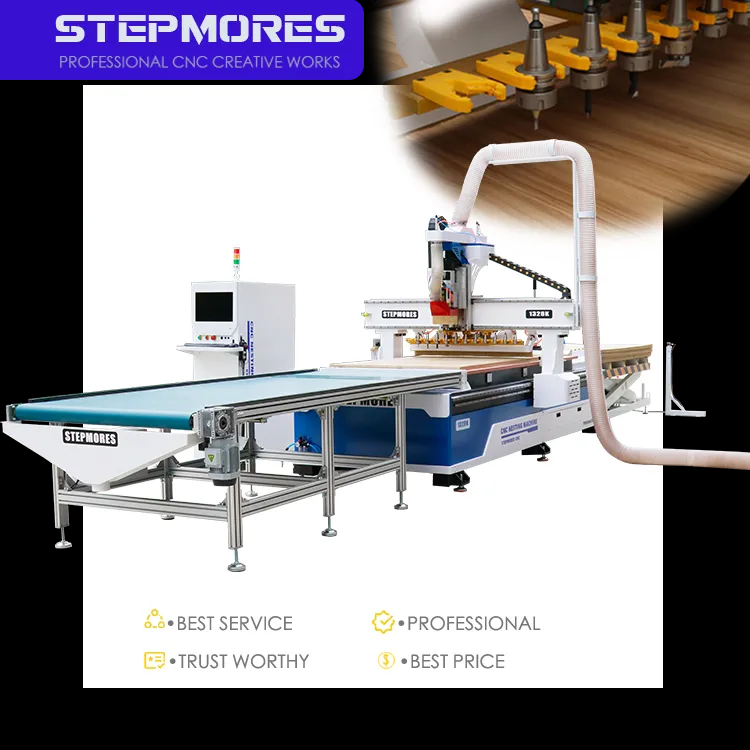
Hardwood machining demands both torque and versatility. An 8–15 HP air-cooled spindle provides the low-end torque to drive large-diameter panel-raising bits through 2″ maple or walnut, while maintaining an RPM range of 6,000–24,000 enables precise chip-load tuning—critical for edge quality. At 18,000–20,000 RPM, a 12 HP spindle cleanly cuts ¾″ plywood or MDF with virtually no tear-out, preserving finish-ready edges for cabinet doors and drawer fronts.
Integrated dust collection is not ancillary—it’s foundational. A dedicated 1,500+ CFM vacuum system with a 4-inch port removes chips before they recirculate, preventing surface marring and premature tool wear. Advanced features—like automatic tool-length measurement, dynamic dust shrouds, and sealed linear rails—further protect machine integrity and operator health. The result is splinter-free routed profiles, predictable tool life, and a safer, cleaner shop environment—key enablers of consistent, high-margin cabinet production.
Size the CNC Router Work Area and Footprint for Sheet-Goods Efficiency and Shop Layout
Standard sheet goods define practical CNC sizing: in North America, 4′×8′ (1220×2440 mm) is the baseline. A true 4×8 table allows full-sheet processing without manual pre-cutting—boosting throughput and minimizing handling errors. Many mid-size shops opt for a 5×10-foot work area instead: the extra space improves nesting efficiency, accommodates oversized panels (e.g., 5′×10′ Baltic birch), and reduces sheet repositioning—cutting cycle time and lowering material waste by up to 15%.
Footprint considerations extend beyond the table. Add 2–3 feet per side for gantry overhang, drive mechanisms, and safe operator access. When integrating into shop layout, prioritize workflow: position the router between raw material storage and downstream assembly to avoid backtracking. A compact 4×8 machine can function effectively in a dedicated 12×15-foot bay, while a 5×10 system typically requires a 15×20-foot zone—including space for dust ducting, loading carts, and emergency egress. Squeezing the machine into a corner or tight corridor compromises safety, ergonomics, and long-term productivity.
Ensure Seamless CNC Router Software Integration with Furniture Design and Nesting Workflows
Native compatibility with Cabinet Vision, Fusion 360, and Mozaik—including nesting, toolpath optimization, and post-processor support
Software integration is the linchpin of modern furniture production. Native support for Cabinet Vision, Fusion 360, and Mozaik eliminates manual file translation, ensuring design intent transfers directly to the machine—preserving dimensions, tolerances, and tooling logic. These platforms embed intelligent nesting algorithms that maximize sheet utilization, routinely reducing plywood waste by 15–20%.
Toolpath optimization goes beyond basic contouring: adaptive clearing, trochoidal milling, and constant engagement strategies maintain consistent tool load—extending bit life and improving surface finish. Equally important is reliable post-processor support: a well-configured post ensures accurate G-code output, including proper tool-change sequences, spindle ramping, and dust-collection synchronization. Together, these capabilities forge a seamless digital thread—from sketch to cut—that accelerates quoting, reduces setup time, and supports agile response to custom orders—making the CNC router a scalable, high-reliability asset in high-mix furniture environments.
Evaluate Total Cost of Ownership for Sustainable CNC Router Adoption in Small-to-Mid Shops
Upfront investment, maintenance (spindle care, wood dust mitigation), and ROI from throughput, labor reduction, and waste minimization
A production-ready 4×8 CNC router for small-to-mid shops typically costs $15,000–$60,000, with $3,000–$5,000 more for essential software, tooling, and dust collection upgrades. While entry-level machines exist, sustainable adoption requires investing in core durability: air-cooled spindles simplify infrastructure but demand disciplined maintenance—bearing replacement every 2–3 years ($500–$1,200) and daily collet cleaning/preload checks. Dust mitigation is non-negotiable: a high-efficiency cyclone collector ($1,500–$3,000) protects ball screws, linear rails, and operator health—directly impacting uptime and TCO.
ROI emerges quickly through three levers: throughput, labor, and material. A CNC router cuts cabinet parts 3–5× faster than manual methods—reducing labor for a full kitchen set from ~40 hours to ~12. Nesting software lifts material yield by 15–20%, translating to measurable plywood savings. For a shop producing five cabinet sets monthly, labor and material gains alone often deliver payback in 12–18 months—before accounting for reduced rework, higher pricing on precision-crafted work, or expanded capacity for custom commissions. True TCO analysis weighs not just acquisition cost, but consistency, scalability, and the ability to retain skilled labor through more engaging, less physically taxing work.
FAQ
What materials can a CNC router handle in furniture production?
A CNC router can handle hardwoods (like oak and maple), plywood, and MDF, each with distinct requirements such as compatible tooling, feed rates, and dust collection systems.
Why is Z-axis travel important for furniture detailing?
Z-axis travel allows controlled depth for raised panels, moldings, and decorative carvings, ensuring precise results in multi-pass strategies and undercuts.
What tolerance levels are essential for precision joinery?
Precision joinery relies on CNC repeatability within ±0.003″ to ensure seamless assembly and high-quality furniture production.
What frame construction is ideal for long-term accuracy?
Heavy-gauge welded steel or cast-iron frames resist vibration and deformation, providing better long-term geometric accuracy compared to lightweight materials.
How does software integration impact CNC router efficiency?
Software tools like Cabinet Vision, Fusion 360, and Mozaik ensure seamless design-to-production workflows with efficient nesting, toolpath optimization, and error-free G-code generation.
Table of Contents
- Align CNC Router Capabilities with Furniture Production Requirements
- Prioritize Structural Rigidity and Mechanical Performance for Repeatable Cabinet-Making
- Size the CNC Router Work Area and Footprint for Sheet-Goods Efficiency and Shop Layout
- Ensure Seamless CNC Router Software Integration with Furniture Design and Nesting Workflows
- Evaluate Total Cost of Ownership for Sustainable CNC Router Adoption in Small-to-Mid Shops
- FAQ