
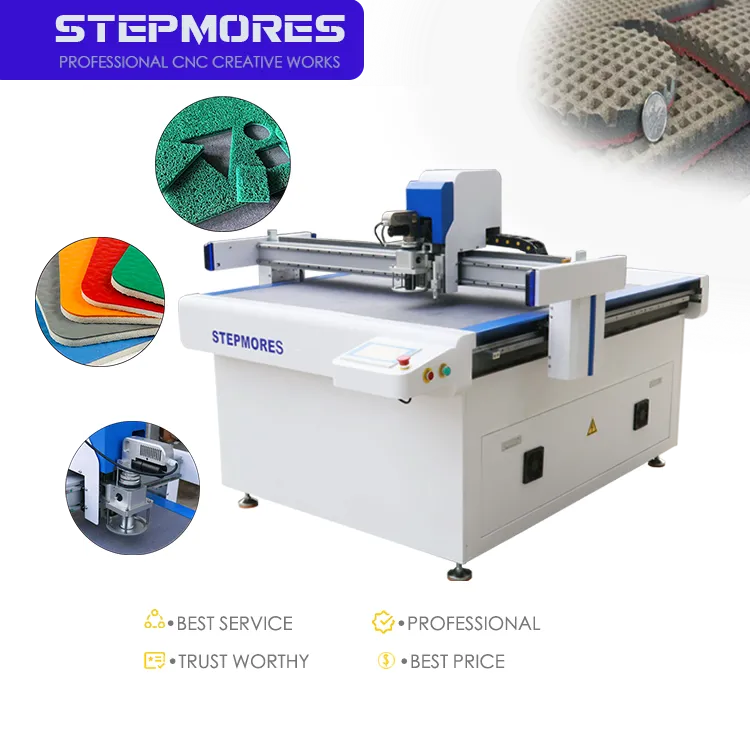
Superior Precision Cutting for Thin, Stretchy, and Layered Materials
Why Traditional Methods Fail: Edge Fraying, Deformation, and Inconsistent Depth on Foam, Technical Textiles, and Composites
Conventional cutting methods struggle with flexible, layered, or heat-sensitive materials—introducing defects that compromise quality, consistency, and yield. Die-cutting excels in high-volume production but suffers from high upfront tooling costs ($5,000–$10,000 per die), long lead times, and mechanical deformation: blunt dies pull and stretch technical textiles, causing edge fraying and dimensional inaccuracies. Laser cutting delivers precision on rigid substrates but poses fundamental limitations for synthetics and composites—the intense thermal energy melts vinyl edges into hardened beads or chars closed-cell foams, while also generating hazardous fumes from polyurethane. Waterjet cutting avoids heat but introduces moisture that can delaminate composites or contaminate absorbent materials like gasket paper. These thermal and mechanical stressors degrade structural integrity and surface quality, underscoring the need for a non-thermal, mechanically precise alternative. According to a 2023 industry report on automated cutting solutions, early adopters of knife-based systems achieved a 12% reduction in scrap rates—driving industry-wide adoption of cold-cutting digital workflows.
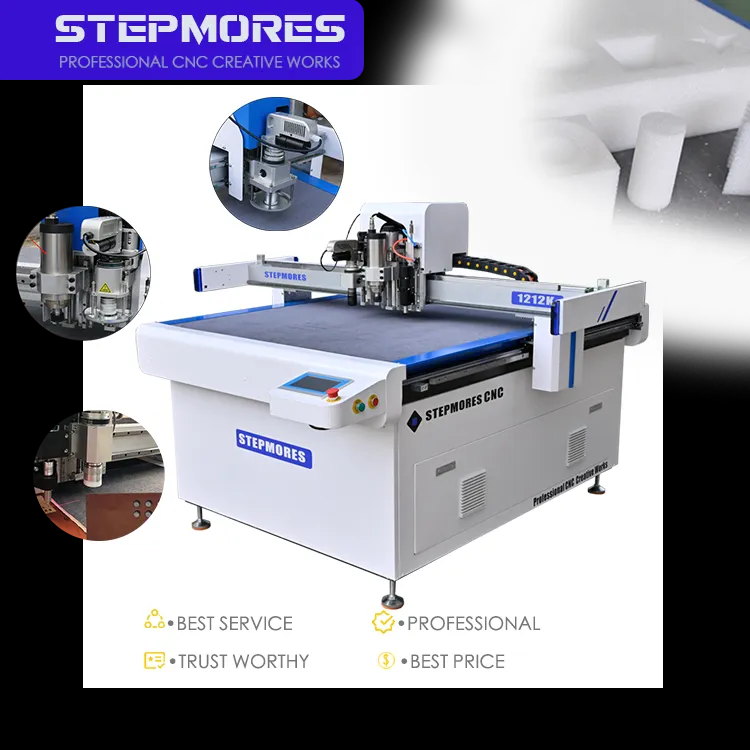
How Oscillating Knife CNC Achieves Sub-0.1mm Accuracy with Zero Thermal Impact and Adaptive Blade Oscillation
Oscillating knife CNC eliminates thermal damage and mechanical distortion through a purely mechanical, software-guided process. A sharp, rapidly oscillating blade “saws” through material without generating heat—preserving chemical stability, preventing edge melting, and eliminating toxic off-gassing. Precision stems not only from blade sharpness but from real-time adaptive control: advanced software dynamically adjusts oscillation frequency, feed rate, and blade angle based on material behavior. For thin, stretchy polymer films, the system increases oscillation speed and slows feed to prevent bunching; for dense, multi-layer composites, it modulates attack angle to ensure perpendicular, coning-free penetration across all strata. This intelligent synergy of arbor speed, kinematic pathing, and blade geometry enables sub-0.1mm dimensional repeatability—transforming prototyping into production-grade output directly from a single digital file.
Significant Cost Reduction Through Die-Less, Cold-Cutting Digital Workflows
Eliminating Die Tooling Costs and Material Waste: Real-World Savings in Leather, Gasket Rubber, and Corrugated Packaging
Oscillating knife CNC eliminates physical dies entirely—removing both capital expense and logistical overhead. Where a custom die for leather or gasket rubber typically costs $5,000–$10,000 and requires weeks for fabrication and validation, digital workflows cut directly from CAD files, slashing setup time and enabling same-day design iteration. In corrugated packaging—where short runs and frequent revisions are standard—die-less operation removes inventory, storage, and obsolescence costs associated with physical tooling. Cold-cutting further reduces waste: no heat-affected zones, no edge deformation, and no trial passes mean clean, first-pass accuracy. Industry data from 2023 confirms up to 30% lower material waste versus traditional methods—particularly impactful for premium substrates like technical textiles and thin foams, where structural integrity must be preserved at every stage.
Smart Nesting + Dynamic Knife Angle & Pressure Control: Boosting Yield by Up to 22% (Verified Benchmarks)
Smart nesting algorithms maximize sheet utilization by intelligently arranging parts to minimize gaps and irregular scrap—especially critical for irregularly shaped components in leather or gasket applications. When paired with dynamic knife control—which continuously adapts oscillation speed, pressure, and tilt based on real-time material feedback—the system maintains edge fidelity across variable thicknesses and densities. For stretchy fabrics or laminated composites, this prevents overcutting, under-cutting, and layer separation. Verified benchmarks from a 2024 manufacturing study show this integrated approach improves material yield by up to 22%, directly lowering per-unit cost and landfill burden. Because cold-cutting ensures consistent depth and clean edges, post-cut trimming is rarely needed—further reducing labor, rework, and throughput delays. With no dies to change or recalibrate, job changeovers occur in seconds—making small-batch and mixed-SKU production as efficient as high-volume runs.
Agile Production Scaling Across Diverse Flexible Materials
Modern B2B manufacturing requires rapid pivots between materials, SKUs, and volumes—without sacrificing precision or throughput. Oscillating knife CNC delivers this agility by replacing fixed tooling with programmable, digitally controlled cutting. A single machine handles technical textiles, foam composites, gasket rubber, and corrugated packaging—all using the same platform and interchangeable blades. Job changes require only a CAD file upload; no die storage, alignment, or mechanical reconfiguration is needed. In a 2024 industry survey, manufacturers reported an 80% reduction in average setup time compared to die-cutting workflows—enabling responsive production to shifting demand signals. Crucially, scalability is seamless: the same system can produce 10 prototype units before lunch and 10,000 production parts by day’s end. This tool-free flexibility transforms static production lines into dynamic manufacturing cells—accelerating time-to-market and eliminating SKU-specific tooling inventory.
Accelerated Time-to-Market and End-to-End Digital Integration
From CAD Design to Traceable Cut Output: How Oscillating Knife CNC Enables Rapid Prototyping and Low-Volume Custom Runs
The digital thread—from CAD design to traceable physical output—removes bottlenecks inherent in die-based processes. Designers upload vector files directly to the CNC system; intelligent software auto-generates optimized toolpaths, applying material-specific presets for foam, technical textiles, or composites. No physical tooling means morning design revisions become afternoon prototypes—compressing traditional lead times from days or weeks to hours. Material setup is instantaneous: blade oscillation, pressure, and angle adapt automatically via embedded job profiles. Each cut piece can be assigned a unique digital identifier, feeding real-time data—including material usage, cycle time, and positional accuracy—into MES or ERP systems. This closed-loop integration delivers full traceability from raw sheet to finished order, empowering agile decision-making, continuous quality monitoring, and confident response to market-driven customization demands.
FAQ: Oscillating Knife CNC Cutting
What are the main advantages of oscillating knife CNC cutting?
Oscillating knife CNC cutting eliminates thermal and mechanical stress, ensuring precision while avoiding material damage. It reduces setup time, tooling costs, and waste.
What materials can be cut using oscillating knife CNC systems?
These systems are versatile and can cut a variety of materials, including technical textiles, foam composites, gasket rubber, corrugated packaging, and stretchy polymers.
How does oscillating knife CNC improve production scalability?
The system's programmable features allow quick pivots between materials and SKUs, ensuring seamless scaling from prototype runs to high-volume production.
Does oscillating knife CNC cutting require additional tooling?
No. It eliminates the need for physical dies, reducing capital expenses and logistical overhead drastically.
How does smart nesting help reduce waste?
Smart nesting algorithms maximize sheet utilization and minimize scrap by intelligently arranging parts.
Table of Contents
- Superior Precision Cutting for Thin, Stretchy, and Layered Materials
- Significant Cost Reduction Through Die-Less, Cold-Cutting Digital Workflows
- Agile Production Scaling Across Diverse Flexible Materials
- Accelerated Time-to-Market and End-to-End Digital Integration
- FAQ: Oscillating Knife CNC Cutting