
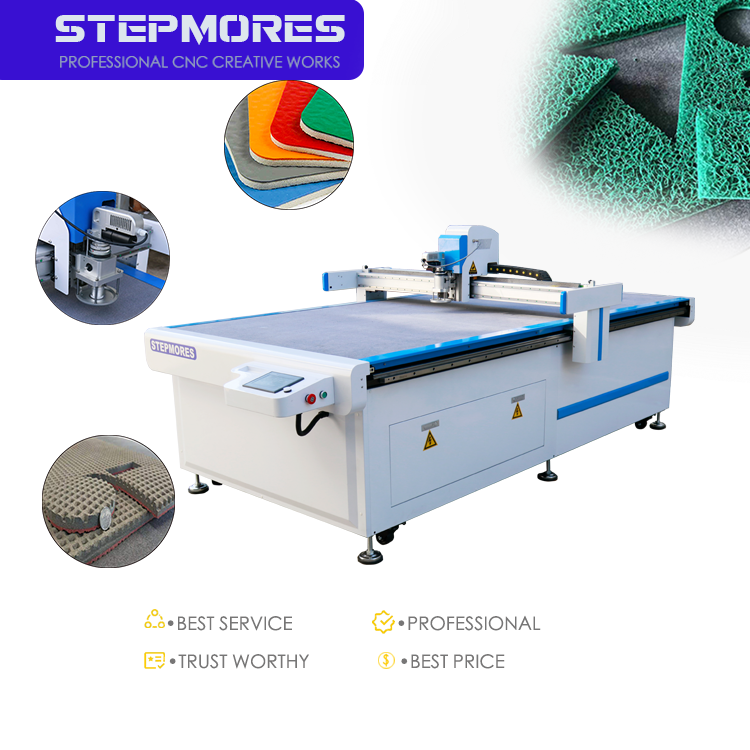
Material Stability Fundamentals for Oscillating Knife CNC
Stable mass-production cutting with an oscillating knife CNC depends on how material hardness, density, and thickness interact. These three variables set blade oscillation frequency, feed rate, and downforce. Balancing them reduces edge deformation, heat buildup, and tool wear.
How Hardness, Density, and Thickness Interact to Enable Stable Oscillating Knife CNC Cutting
Hardness sets the lower bound for blade sharpness and downforce. Dense materials such as graphite-epoxy composites resist lateral blade movement, while soft, low-density foams compress before the edge bites. Thickness determines how many oscillation cycles engage the cut zone. For stable results, operators tune stroke rate within the typical 3,000–15,000 strokes per minute range and reduce feed speed when hardness or density rises. A 40 Shore A nitrile sheet at 30 mm may cut cleanly at 12,000 strokes/min and 0.8 m/s, but the same thickness in high-density phenolic needs slower feed and higher downforce to avoid delamination. Kerf width also shifts from 0.3 mm in rigid board to 0.8 mm in compressible foam. Process engineers often monitor edge temperature and scrap rate during first article inspection. A rise in either signals that hardness or density has shifted beyond the preset window. This closed-loop adjustment keeps continuous runs within tolerance. No single parameter works alone—hardness, density, and thickness must be evaluated together before locking a production recipe.
The Critical Thickness Thresholds Across Material Categories for High-Volume Runs
High-volume output depends on respecting thickness ceilings. Oscillating knife CNC systems generally cut up to 100 mm, but stable single-pass limits vary sharply by material category.
| Material category | Typical stable single-pass thickness | Common instability beyond threshold |
|---|---|---|
| Silicone and nitrile rubber (20–60 Shore A) | 30–50 mm | edge compression, blade deflection |
| EVA and filter foam | 60–100 mm | fluttering, uncut fibers, bottom melt risk |
| Graphite and epoxy board | 10–20 mm | edge chipping, thermal drift, delamination |
| Corrugated and honeycomb board | 15–25 mm | flute crushing, tear-out, adhesive drag |
Exceeding these thresholds forces lower feed rates and increases scrap. Low-density EVA tolerates thicker cuts because the blade path compresses and recovers without heat. High-density phenolic behaves like a rigid board and must stay below 20 mm to avoid chipping. In mass production, engineers often set a 70–80% threshold of the tested maximum to preserve repeatability—keeping kerf variation within 0.3–0.8 mm and positional accuracy near ±0.1 mm. This conservative margin also protects blade life on abrasive graphite and epoxy board. Multi-pass strategies can push thickness higher, but cycle time and edge consistency often degrade. Selecting a category-specific threshold before high-volume runs prevents unplanned downtime. Ultimately, stable mass production is a function of respect for these material limits, not raw machine capability.
Elastomeric & Sealing Materials: Rubber, Silicone, Graphite, and Epoxy Board
Elastomeric and sealing materials demand stable cutting parameters to avoid edge deformation and dust contamination. A well-tuned oscillating knife CNC system achieves this by synchronizing blade speed, oscillation frequency, and feed rate.
Silicone and Nitrile Rubber (20–60 Shore A): Consistent Edge Quality and Delamination Control
Silicone and nitrile rubber in the 20–60 Shore A range combine low hardness with high surface friction—conditions that can cause blade deflection and edge tearing if parameters drift. For stable cuts, operators should pre-cool sheets to 10–15°C and use a 30–45° single-bevel knife at 8,000–12,000 oscillations per minute. Lower oscillation rates generate pulling forces that stretch thin gasket sections; excessive speeds overheat the material and create tacky edges. Feed rates between 800 and 1,200 mm/min help maintain uniform kerf width and reduce delamination risk. Replace blades after 500 linear meters to maintain clean edges and prevent rebound delamination. Vacuum hold-down with a sacrificial cutting mat prevents upward edge lift and supports repeatable, delamination-free results.
Graphite and Epoxy Board: Mitigating Chipping and Thermal Drift in Continuous Oscillating Knife CNC Cuts
Graphite and epoxy board combine brittle filler with resin-rich surfaces, so edge chipping and thermal drift are the main failure modes in long runs. A downward-cutting blade orientation exerts pressure into the substrate and suppresses top-edge breakout. Operators should use a 25 mm high-speed steel knife with 45° bevel and keep oscillation amplitude below 2 mm to limit impact microcracks. For graphite, maintaining room-temperature sheets and dry cutting avoids resin softening. For epoxy board, reducing feed rate to 600–900 mm/min and adding a light air blast removes chip residue before it re-welds to the cut edge. Thermal imaging during a continuous-cutting study showed that tool interface temperature rose only 8°C over 90 minutes when feed and oscillation limits were applied. This stability keeps dimensional drift below ±0.1 mm and supports uninterrupted production of gaskets, thermal pads, and insulator plates.
Foam & Acoustic Materials: Optimizing Oscillating Knife CNC for EVA, Phenolic, and Filter Foams
Low-Density EVA vs. High-Density Phenolic: Matching Blade Oscillation Frequency to Foam Compression Recovery
Low-density EVA foam compresses and rebounds quickly, so an oscillating knife CNC with excessive vertical stroke frequency can tear cell walls and leave fuzzy edges. High-density phenolic foam resists penetration and generates frictional heat; a slower oscillation frequency combined with greater amplitude improves chip evacuation and prevents edge crumbling. To keep mass production stable, technicians should match blade dwell to each material’s compression recovery time—EVA tolerates quicker strokes, while phenolic benefits from reduced speed plus vacuum hold-down. Open-cell filter foams need moderate frequency and a sharp single-bevel blade to avoid pore collapse. Testing each foam lot before a full run locks in the stroke rate and bevel angle for repeatable edge quality. This parameter mapping reduces scrap and supports high-volume acoustic foam cutting.
Packaging & Structural Boards: Achieving Tear-Free Mass Production on Corrugated, Honeycomb, and Grey Board
Flute Orientation, Adhesive Bond Strength, and Knife Angle Calibration for Reliable Oscillating Knife CNC Board Cutting
Reliable oscillating knife CNC cutting of corrugated, honeycomb, and grey board depends on matching tool motion to board structure. Flute orientation is primary: cutting parallel to corrugation flutes yields cleaner edges than cutting across open flute cells, which can collapse or fray. Adhesive bond strength between linerboard and fluting also affects tear resistance; weak or aged bonds separate under blade oscillation, leaving fuzzy edges. Knife angle calibration matters equally. A steeper bevel reduces top-surface crushing on honeycomb face sheets, while a shallow angle slices grey board without dragging fibers. For high-volume runs, test flute direction, bond quality, and blade angle on sample sheets—this prevents core collapse and edge fraying at scale. A leading packaging supplier reported that a 3° knife angle adjustment reduced edge defects by 40% on double-wall corrugated board.
FAQ Section
What is an oscillating knife CNC?
An oscillating knife CNC is a cutting system that uses a blade with rapid back-and-forth motion to cut materials precisely. It is especially useful for cutting soft, thick, or fibrous materials.
Why are hardness, density, and thickness important in oscillating knife CNC cutting?
These factors determine optimal blade oscillation frequency, feed rate, and downforce. Proper balance between them minimizes tool wear, heat buildup, edge deformation, and material scrap in production.
How do different materials affect cutting parameters?
Materials like silicone, rubber, foam, and graphite have different properties that require specific cutting parameters related to stroke rate, feed speed, oscillation amplitude, and knife angle for optimal performance.
What are typical thickness thresholds for different materials?
Stable single-pass thickness limits vary by material category. For instance, EVA and filter foam have higher thickness ceilings than dense graphite-epoxy boards, which demand more controlled conditions for cutting.
How can edge chipping and deformation be minimized?
Edge chipping can be minimized by using the correct knife orientation, bevel angle, feed rate, and oscillation amplitude. Testing material-specific parameters before production is crucial.
What are the common challenges with specific materials like silicone or phenolic foam in CNC cutting?
Silicone and nitrile rubber may cause edge tearing or blade deflection, while phenolic foam can generate frictional heat and edge crumbling. Proper tuning of cutting parameters will prevent these issues.
Table of Contents
- Material Stability Fundamentals for Oscillating Knife CNC
- Elastomeric & Sealing Materials: Rubber, Silicone, Graphite, and Epoxy Board
- Foam & Acoustic Materials: Optimizing Oscillating Knife CNC for EVA, Phenolic, and Filter Foams
- Packaging & Structural Boards: Achieving Tear-Free Mass Production on Corrugated, Honeycomb, and Grey Board
-
FAQ Section
- What is an oscillating knife CNC?
- Why are hardness, density, and thickness important in oscillating knife CNC cutting?
- How do different materials affect cutting parameters?
- What are typical thickness thresholds for different materials?
- How can edge chipping and deformation be minimized?
- What are the common challenges with specific materials like silicone or phenolic foam in CNC cutting?