
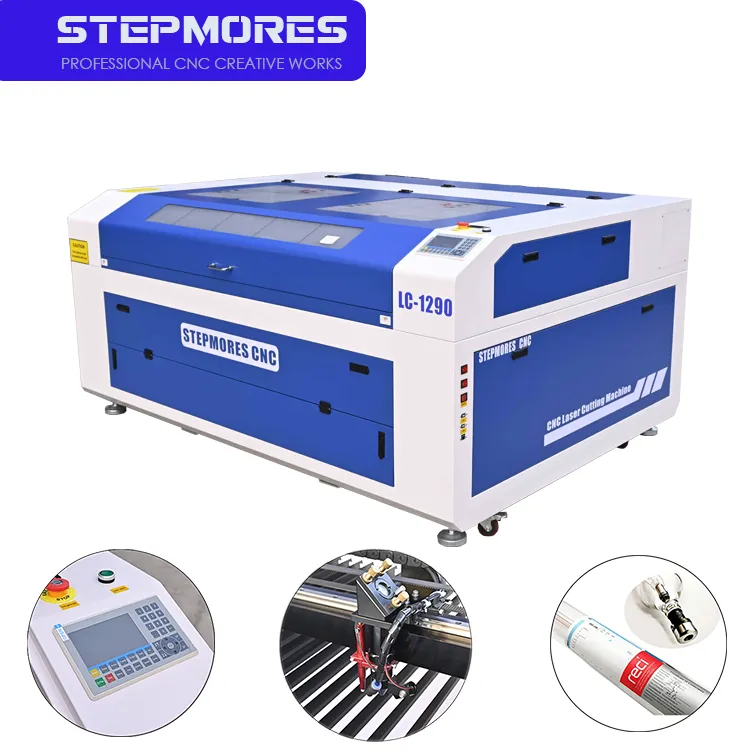
Superior Speed and Throughput with CNC Fiber Laser Cutting Machine
Speed gains come from two connected improvements: faster beam response and motion systems that minimize non-cutting time.
Sub-millisecond beam response and high acceleration motion control
Fiber lasers achieve sub-millisecond beam modulation—ramping power up or down in under one millisecond. Unlike CO₂ lasers, which rely on slower gas excitation or mechanical apertures, this near-instantaneous control prevents burn-through on thin sheet metal and eliminates hesitation at corners or feature transitions. Paired with a lightweight cutting head, the system enables high-acceleration motion control, allowing rapid direction changes and tighter nesting without sacrificing edge quality. Advanced systems reach travel speeds up to 1,200 inches per minute (3,050 cm/min), translating into more parts per shift and significantly shorter total job cycle times.
Real-world performance: 47% faster cut cycle time vs. CO₂ lasers in automotive production
A 2023 benchmark in automotive sheet metal operations found CNC fiber laser cutting machines completed identical jobs 47% faster than CO₂ lasers. This improvement stems from faster piercing, higher sustained feed rates on coated steel and aluminum, and reduced dwell time between features. Fiber lasers also require virtually no warm-up, enabling immediate production after shift changes or material swaps. Their 1.07 µm wavelength couples more efficiently with metal surfaces, converting more input energy into effective cutting power—reducing the need for secondary passes or post-cut cleaning. The result is not just faster part output, but smoother downstream flow through press, welding, and assembly stations.
Precision and Energy Efficiency of CNC Fiber Laser Cutting Machine
Micron-level accuracy enabled by fiber laser beam quality (M² < 1.1)
CNC fiber laser cutting machines use sources with near-diffraction-limited beam quality—M² values consistently below 1.1. This produces an exceptionally tight focal spot and narrow kerf, minimizing heat-affected zones and thermal distortion. Combined with the shorter 1.07 µm wavelength’s superior absorption in metals, the system delivers stable, repeatable cuts with tolerances under 0.1 mm—and often within ±5 µm positioning accuracy. These capabilities support intricate geometries, sharp internal corners, and fine-feature holes in sheet metal, electronics enclosures, and medical device components—often eliminating the need for secondary finishing.
30–50% lower energy consumption per unit volume vs. CO₂ lasers (NIST 2023)
According to NIST 2023 data, fiber laser systems consume 30–50% less energy per unit volume of material removed than CO₂ lasers. This stems from higher electrical-to-optical conversion efficiency—typically ≥30% for fiber lasers versus 10–15% for CO₂—along with minimal waste heat generation. Lower thermal load reduces chiller and ventilation demands, cutting overall plant energy use. With no gas circulation systems or resonator alignment requirements, maintenance is simpler and more predictable. As a result, operating cost per part declines, making CNC fiber laser cutting a more sustainable and cost-effective solution—especially under rising electricity costs or carbon reporting mandates.
Intelligent CNC Control: Enabling Repeatability, Automation, and Adaptive Cutting
Modern CNC fiber laser cutting machines integrate intelligent control systems that transform static toolpaths into responsive, self-correcting processes—supporting consistent quality, lights-out operation, and robust adaptation to real-world material variability.
Closed-loop servo systems + EtherCAT for <10 µm positional repeatability
Closed-loop servo control—using rotary and linear encoders to continuously verify axis position—forms the foundation of precision and consistency. Coupled with EtherCAT fieldbus communication (sub-1 ms update cycles), the CNC compares commanded and actual positions thousands of times per second. This minimizes following error, thermal drift, and mechanical backlash. In practice, such systems achieve positional repeatability below 10 µm across extended runs—even on dense hole patterns and fine slots. Independent testing on 3 mm stainless steel grids confirmed ±8 µm repeatability (2023). Tight multi-axis synchronization prevents corner overshoot and vibration-induced striations, while adaptive servo tuning maintains edge quality whether handling light-gauge foil or heavy plate.
Dynamic parameter optimization for varying material thickness and alloy composition
Adaptive algorithms monitor real-time process signals—including reflected light intensity, assist gas pressure, and cut front temperature—to automatically adjust laser power, focal position, travel speed, and nozzle standoff. For example, the system applies higher speed and lower power density for 1 mm aluminum, versus slower, higher-energy parameters for 10 mm carbon steel. A dynamic parameter library, continually refined by sensor feedback, reduces burrs and narrows the heat-affected zone. Mixed-material batches—such as stainless steel, mild steel, and aluminum—require no manual reprogramming. Operators simply load different sheets; the machine selects and refines optimal settings on-the-fly. Over time, the controller learns from prior cuts to compensate for surface coatings, minor rust, or residual stress—ensuring consistent kerf width and edge quality across thicknesses from 0.5 mm to 25 mm and across diverse alloy families.
Operational ROI: Reduced Downtime and Labor Costs with CNC Fiber Laser Cutting Machine
For most manufacturers, the strongest return on investment from a CNC fiber laser cutting machine comes not from raw speed alone—but from dramatic reductions in labor, downtime, and maintenance overhead.
Automated material handling and closed-loop process control routinely reduce operator headcount by 50–70% compared to manual or semi-automated setups. At the same time, stable operating parameters and simplified source architecture lower lifetime maintenance costs by 30–40%. High-volume shops bringing outsourced work in-house often achieve full payback in as little as six months; smaller operations typically reach positive ROI within 18–24 months.
Key drivers include:
- Advanced nesting software boosting sheet utilization above 90%, directly lowering raw material cost.
- Automatic loading, unloading, and part sorting slashing direct labor hours per part.
- Elimination of secondary deburring and edge-finishing steps—removing handling, inspection, and rework.
- Unattended operation converting off-shift hours into productive capacity—without added labor cost.
Financially, annual net benefit includes labor savings, increased production value, scrap reduction, and avoided outsourcing fees. Annual cost covers depreciation or financing, utilities, assist gas, maintenance, software licensing, and training. Using standard ROI calculation (total investment ÷ annual net benefit), teams consistently find a compelling shift from variable, high-cost external suppliers or labor-intensive internal processes to predictable, scalable in-house production—with fewer unplanned interruptions and higher first-pass yield.
FAQs About CNC Fiber Laser Cutting Machine
What is the main advantage of CNC fiber laser cutting machines over CO₂ lasers?
CNC fiber laser cutting machines offer faster beam response, higher cutting speeds, better precision, lower energy consumption, and reduced maintenance compared to CO₂ lasers. They also enable immediate production without warm-up time and deliver higher overall efficiency.
How do fiber lasers achieve high cutting speed?
Fiber lasers achieve high speeds through sub-millisecond beam modulation and high-acceleration motion control, which minimizes non-cutting time and enhances the ability to handle intricate geometries and rapid direction changes.
Are CNC fiber laser cutting machines energy-efficient?
Yes, CNC fiber laser cutting machines consume 30–50% less energy per unit volume compared to CO₂ lasers. This is due to their higher electrical-to-optical conversion efficiency, reduced heat generation, and simpler source architecture.
How does the intelligent control system in CNC fiber lasers work?
Modern CNC fiber lasers incorporate closed-loop servo systems and adaptive algorithms that monitor real-time signals to automatically adjust cutting parameters, ensuring consistent precision and optimal performance across various material types and thicknesses.
What is the return on investment (ROI) for CNC fiber laser cutting machines?
ROI is typically high due to reduced labor costs, minimized downtime, increased production efficiency, and lower maintenance. High-volume operations can achieve full payback in six months, while smaller businesses often reach positive ROI within 18–24 months.
Table of Contents
- Superior Speed and Throughput with CNC Fiber Laser Cutting Machine
- Precision and Energy Efficiency of CNC Fiber Laser Cutting Machine
- Intelligent CNC Control: Enabling Repeatability, Automation, and Adaptive Cutting
- Operational ROI: Reduced Downtime and Labor Costs with CNC Fiber Laser Cutting Machine
-
FAQs About CNC Fiber Laser Cutting Machine
- What is the main advantage of CNC fiber laser cutting machines over CO₂ lasers?
- How do fiber lasers achieve high cutting speed?
- Are CNC fiber laser cutting machines energy-efficient?
- How does the intelligent control system in CNC fiber lasers work?
- What is the return on investment (ROI) for CNC fiber laser cutting machines?