
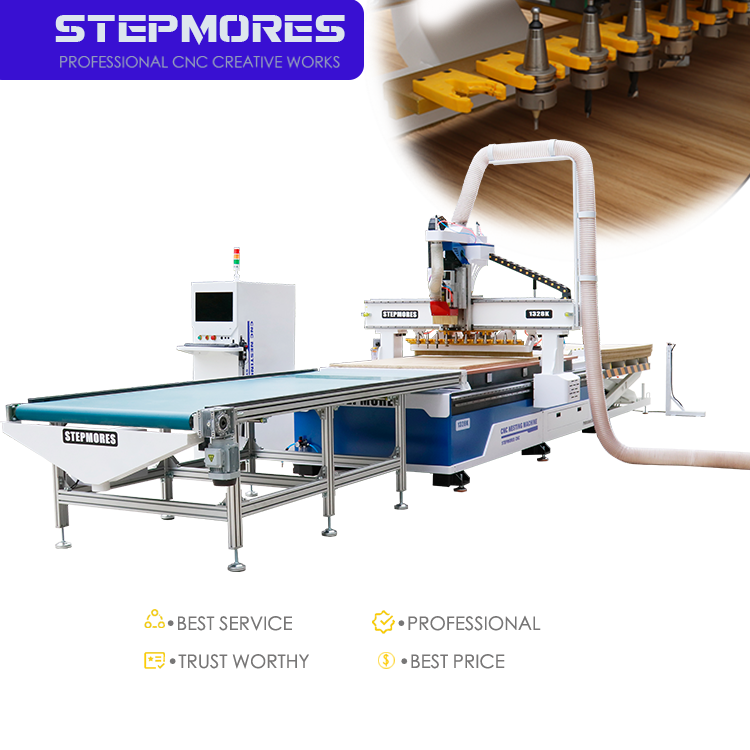
Match CNC Router Rigidity and Construction to Your Production Volume
The frame of a CNC router is the primary factor in holding cutting tolerances under load. For woodworking, match construction to your daily operating hours and part volume. Entry-level machines—typically priced between $1,000 and $15,000—often use aluminum extrusion or light steel frames and are rated for 1–4 hours of daily operation. These systems deliver ±0.1–0.3 mm accuracy, making them suitable for prototyping, hobby work, or low-volume custom furniture. In contrast, production-grade routers (usually $40,000 and up) feature heavy welded steel or cast-iron frames, closed-loop servo drives, and are engineered for multi-shift or 24/7 operation. Such machines consistently achieve ±0.02–0.05 mm repeatability across thousands of parts.
If your weekly output regularly exceeds 40–60 sheet goods—or if consistent joinery tolerances are critical—prioritize a gantry and base with thick wall sections, stress-relieved steel, and dual-drive gantry movement. Welded or stress-relieved joints outperform bolted connections in high-volume environments. Machine weight per square meter of table area serves as a practical proxy for rigidity: heavier, welded bases dampen vibration more effectively than lightweight extrusion frames. This rigidity directly reduces tool deflection and vibration, improving edge quality and extending tool life. Avoid overspending on a production-grade frame if your duty cycle is light; instead, align rigidity with your actual tolerance targets and operational demands. This decision also influences maintenance frequency and long-term part consistency.
Evaluate Spindle Performance and Work Bed Design for Wood-Specific Needs
Spindle Power, Cooling, and Speed Control for Clean, Efficient Wood Cutting
Spindle performance dictates cut quality, surface finish, and throughput. For solid wood and plywood, select a spindle rated between 3.5–9 kW: softwoods and light MDF typically require only 3.5 kW, while dense hardwoods and deep passes demand at least 6 kW. Air-cooled spindles offer simplicity but risk overheating during extended runs; water-cooled units maintain stable temperatures and reduce noise—ideal for continuous production. Variable frequency drive (VFD) control should span 7,000–24,000 RPM, enabling optimal speeds for both small-diameter engraving bits and large surfacing tools. Crucially, verify that the spindle delivers consistent torque at low RPM—torque drop causes chatter and uneven surfaces when using large-diameter bits. Ceramic bearings and automatic tool calibration minimize runout and setup variation. A 2023 industry benchmark found that closed-loop speed control reduced burn marks by 18% and sanding time by 12% compared with fixed-speed spindles—extending bit life and improving edge finish on hardwoods, laminates, and veneered panels.
Work Bed Type and Fixture Clearance for Part Size, Material Handling, and Workflow Flexibility
The work bed must support your part geometry, material types, and batch volume. Vacuum tables with T-slot inserts enable fast, secure sheet hold-down and suit nested-based production of case goods and cabinet parts. For small or irregular solid wood pieces, mechanical clamps paired with sacrificial spoil boards provide greater fixture precision and clearance control. When evaluating usable bed area, compare it against your largest panel: a 1,300 mm × 2,500 mm bed accommodates standard plywood sheets but leaves minimal margin for multi-zone nesting. Split vacuum zones or modular phenolic beds improve airflow distribution and simplify cleanup. Quick-change fixture plates or pop-up pins can slash changeover time—from 25 minutes down to under 8 minutes, according to 2024 workflow data. Ensure sufficient gantry clearance above the bed to accommodate tall workpieces and clamps without collision. The ideal bed design supports both full-sheet nesting and small-part rework, eliminating the need for constant reconfiguration between prototypes and production runs.
Assess CNC Router Travel, Z-Axis Reach, and Nesting Compatibility
Effective Working Envelope vs. Nested Part Layout Requirements
Your CNC router’s effective working envelope—not just nominal table size—must exceed your largest nested sheet blank to allow for tool clearance, fixture placement, and safe rapid moves. While many shops run 4 × 8 ft panels, 5 × 12 ft stock is common in cabinet and closet manufacturing. If the machine cannot fully cover that sheet, operators must break nests into sections or re-fixture parts—increasing labor, scrap risk, and alignment errors. Aim for at least 6–12 inches of extra travel on both X and Y axes beyond your planned material dimensions. Critically, verify usable width under the gantry, not just table size: vacuum zone boundaries and spoilboard overhangs can shrink true cutting area by several inches. Match travel, acceleration, and rapid traverse speed to your highest-volume nested layout—not maximum nominal specs.
Z-Axis Depth, Anti-Dive Stability, and 3D Profiling Capability for Joinery and Moulding
Z-axis reach must accommodate your thickest workpiece plus tool length and safe retract height. For precision joinery—including tenons, dovetails, and deep mortises—vertical plunge stability is non-negotiable. Side deflection during aggressive cuts degrades fit and repeatability. Look for anti-dive features such as counterbalance cylinders, servo braking, or mechanical locks to prevent spindle drift. Greater Z stroke enables 3D profiling of curved mouldings, raised panels, and contoured chair seats—but extended travel increases vibration risk unless the gantry and Z assembly are well-braced. Evaluate vertical repeatability under load, especially when switching between shallow engraving and deep profiling operations. Compact, rigid Z assemblies often outperform taller, lightly constructed designs in edge finish, fine detail retention, and long-term reliability.
Prioritize Smart CNC Router Features That Boost Long-Term Productivity
Automatic Tool Changer (ATC) Integration and Nesting Software Readiness
As woodworking shifts from one-off jobs to repeat batches, manual tool changes become a hidden bottleneck. An Automatic Tool Changer (ATC) allows seamless swapping between roughing, finishing, drilling, and grooving tools—without operator intervention. In 2023 benchmarking across small-to-midsize wood shops, ATC-equipped machines reduced non-cut time by 25–40% on nested cabinet parts. When paired with advanced nesting software that optimizes part placement across available sheet area, material waste drops significantly while throughput rises. This integration also enables unattended operation for routine panel runs—even smaller batches benefit from faster, more predictable changeovers.
Multi-Axis Motion Support and IoT-Ready Infrastructure for Future Scalability
A CNC router with 4- or 5-axis motion expands capability beyond flat-panel processing: deeper joinery, undercuts, and multi-face carving become possible without manual repositioning—reducing setups and preserving part alignment on complex wood components. Equally important is IoT-ready infrastructure: remote monitoring, real-time spindle load tracking, and predictive maintenance alerts help operators detect wear before it triggers downtime. A 2024 trend report from a leading machine builder found that manufacturers leveraging connected machine data achieved 15–20% higher asset utilization. Choose a platform designed to accept future software updates and sensor upgrades—it will scale with evolving product requirements, avoiding premature replacement.
FAQ
What is the importance of CNC router rigidity for woodworking?
Rigidity in a CNC router directly affects cutting tolerances, vibration reduction, tool deflection, and the overall quality of edge finishes. High rigidity is especially crucial for high-volume or production environments.
How can spindle power influence the cutting process?
Spindle power determines cutting accuracy, surface finish, and throughput. The appropriate power depends on the material type—low-power spindles are sufficient for softwoods, while high-power spindles are better for dense hardwoods and deep passes.
Why is the work bed design significant for CNC woodworking?
The work bed supports material handling, part geometry, and batch volume. Design features like vacuum tables, split zones, and adjustable clearance ensure flexibility and efficiency in nesting and rework processes.
What features enhance long-term CNC router productivity?
Automatic Tool Changer (ATC) integration, advanced nesting software, multi-axis motion capabilities, and IoT-ready infrastructure are key features that significantly boost efficiency and scalability over time.