
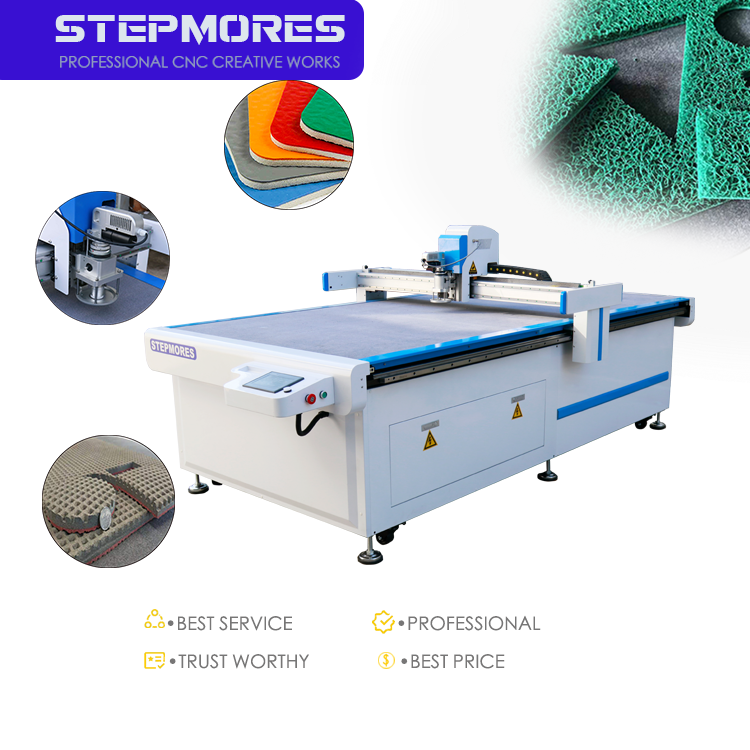
Why Oscillating Knife CNC Delivers Superior Speed on Flexible Materials
Dynamic Blade Engagement Minimizes Deformation and Drag
Flexible materials like foam, felt, and fabric tend to buckle or stretch under static knife pressure, causing drag and dimensional errors. An oscillating knife CNC system avoids these issues by moving the blade in rapid vertical micro-strokes—typically up to 15,000 strokes per minute—while the toolhead traverses. This dynamic engagement creates a saw-like cutting action that separates fibers cleanly without deforming the surrounding material. Because the force is applied in short bursts, the blade slices through compliant substrates with minimal friction, reducing mechanical load on the gantry and enabling higher feed rates. The result is a smooth, drag-free cut that maintains shape accuracy while allowing cutting speeds of up to 2 meters per second on common nonwoven and textile materials—translating directly to faster cycle times without sacrificing quality.
Real-World Impact: 42% Average Cycle Time Reduction in Automotive Non-Woven Gasket Production
A production line manufacturing automotive non-woven gaskets replaced conventional drag knives with an oscillating knife system—and achieved a 42% average reduction in cycle time per part. The operation required cutting complex gasket shapes from dense, compressible felts with tight tolerances. The oscillating knife’s ability to maintain a clean cut without material bunching eliminated frequent slowdowns for repositioning and rework. Moreover, reduced deformation allowed the system to run at 30–50% higher linear speeds without edge fraying. Engineers observed not only faster outputs but also more consistent part dimensions, lowering scrap rates. This outcome underscores how dynamic blade engagement directly boosts throughput in high-mix, flexible-material environments.
Material-Specific Oscillating Knife CNC Speed Optimization
Optimal Feed Rates by Material Class: Foam, Felt, and Woven Fabric
The feed rate of an oscillating knife CNC must be calibrated to the material’s density, hardness, and thickness to avoid fraying, tearing, or excessive blade wear. For foam materials (e.g., polyurethane, EVA), low density and high compressibility allow faster cutting—typically 500–800 mm/s—while thicker foams may require reduced speeds to maintain edge quality. Felt, with its fibrous and slightly resilient nature, demands a slower pace, commonly 300–500 mm/s, to prevent fuzz and edge distortion. Woven fabrics—especially those with delicate weaves—are the most sensitive; feed rates around 200–400 mm/s paired with higher oscillation frequencies minimize thread pull and cut smoothly. As confirmed in the Journal of Manufacturing Processes (2022), aligning feed rate with blade oscillation frequency reduces edge defects by up to 35%. The table below summarizes optimal ranges.
| Material Class | Typical Density/Hardness | Recommended Feed Rate (mm/s) | Notes |
|---|---|---|---|
| Foam (PU, EVA) | Low | 500–800 | Higher rates for thinner sheets |
| Felt | Medium | 300–500 | Increase oscillation frequency for cleaner edges |
| Woven Fabric | Low to Medium | 200–400 | Use sharp, fine-tooth blades, high oscillation |
Adaptive Speed Control Using Real-Time Thickness Sensors
Adaptive speed control—using real-time thickness sensors such as ultrasonic or laser profile scanners—enables oscillating knife CNC systems to automatically adjust feed rate, oscillation amplitude, and knife stroke based on material variations. When the sensor detects a thicker section, the system momentarily reduces speed to maintain cut quality; on thinner areas, it accelerates to maximize throughput. A 2024 analysis in the International Journal of Advanced Manufacturing Technology reported an average 18% productivity gain with such dynamic compensation. This approach eliminates operator trial-and-error, reduces scrap, and ensures consistent dimensional accuracy across full production runs. Integrated with modern CNC controllers, thickness-adaptive algorithms can process multi-layer or inhomogeneous materials without pre-programming, dramatically streamlining job setup.
Oscillating Knife CNC vs. Alternative Cutting Methods: Speed and Quality Trade-Offs
Oscillating vs. Drag Knife: Balancing Edge Precision and Through-Cut Velocity
A drag knife cuts by pulling a stationary blade through material, relying on tangential rotation to keep the tip aligned with the vector of the cut. This method yields very smooth edge finishes on thin, low-friction media like vinyl or paper. However, on thicker or high-fiber materials such as automotive felt and dense foam, friction increases, causing blade deflection and requiring slower feed rates to prevent buckling. An oscillating knife CNC overcomes this limitation with high-frequency reciprocating motion that reduces overall drag. Its rapid up-and-down movement severs fibers incrementally, minimizing resistance and enabling through-cut speeds often 30–50% higher than drag knife configurations. While the drag knife may still produce a microscopically cleaner edge on delicate films, the oscillating knife’s speed advantage is decisive for production environments where cycle time reduction is paramount—the slight roughening of the cut face is easily acceptable for most flexible material applications.
Advantages Over Routing: No Chatter, Minimal Heat, and Instant Toolpath Response
CNC routers rely on high-speed rotating bits that remove material by abrasion. On flexible substrates, this generates friction heat that can melt synthetic fibers or leave burn marks, and lateral cutting forces often cause chatter—vibrations that degrade edge quality and accuracy. In contrast, a dedicated oscillating cutting head uses a non-rotational, cold-cutting principle. The blade oscillates vertically, slicing through material without generating significant heat or side loads, eliminating chatter entirely. This allows the machine to execute intricate contours with instantaneous toolpath changes at full speed, without the deceleration ramps routers require for sharp corners. The result is a notable cycle time advantage: straight and curved cuts are completed in a single, fluid motion, while avoiding secondary deburring or cleaning steps common with routed parts.
Key Oscillating Knife CNC Parameters That Maximize Cutting Efficiency
Tip Angle and Oscillation Frequency Synergy for High-Compliance Materials
High-compliance materials like soft foams and textiles deform easily under blade pressure. An oscillating knife CNC’s tip geometry and oscillation frequency must align to prevent material dragging. A slender, acute tip angle reduces entry force, while high-frequency reciprocation (8,000–12,000 cycles per minute—or up to 24,000 rpm for denser layers) creates a micro-sawing action that severs fibers without bunching. Research indicates that when feed rate mismatches vibration frequency, edge defects rise by 25–40% (CNC Interpolation and Motion Control, Springer, 2022). Synchronizing these parameters ensures a clean through-cut as each downstroke advances the tool by no more than the blade’s effective cutting edge length—maximizing both throughput and dimensional accuracy.
FAQ
What is an oscillating knife CNC system?
An oscillating knife CNC system is a machine tool that uses rapid vertical micro-strokes to cut materials, instead of dragging or rotating a blade. This enables precise cutting of flexible materials like foam, felt, and fabric.
How does an oscillating knife CNC system minimize material deformation?
The oscillating knife system applies dynamic blade engagement, where short bursts of vertical motion minimize drag and deformation, enabling clean and accurate cuts on flexible substrates.
What materials are best suited for oscillating knife CNC systems?
Common materials include foam (PU, EVA), felt, woven fabrics, and other flexible or compressible substrates. Feed rates and blade oscillation frequencies can be adjusted based on material type and thickness.
How does oscillating knife CNC compare to drag knife systems?
Oscillating knife CNC systems are faster and more effective for thicker, high-fiber materials, while drag knife systems are better for thin, low-friction media like vinyl and paper.
Can oscillating knife CNC systems handle intricate patterns?
Yes, the non-rotational, cold-cutting principle of oscillating knives allows for intricate toolpath changes at high speeds, making them ideal for complex shapes and contours.
Table of Contents
- Why Oscillating Knife CNC Delivers Superior Speed on Flexible Materials
- Material-Specific Oscillating Knife CNC Speed Optimization
- Oscillating Knife CNC vs. Alternative Cutting Methods: Speed and Quality Trade-Offs
- Key Oscillating Knife CNC Parameters That Maximize Cutting Efficiency
-
FAQ
- What is an oscillating knife CNC system?
- How does an oscillating knife CNC system minimize material deformation?
- What materials are best suited for oscillating knife CNC systems?
- How does oscillating knife CNC compare to drag knife systems?
- Can oscillating knife CNC systems handle intricate patterns?