
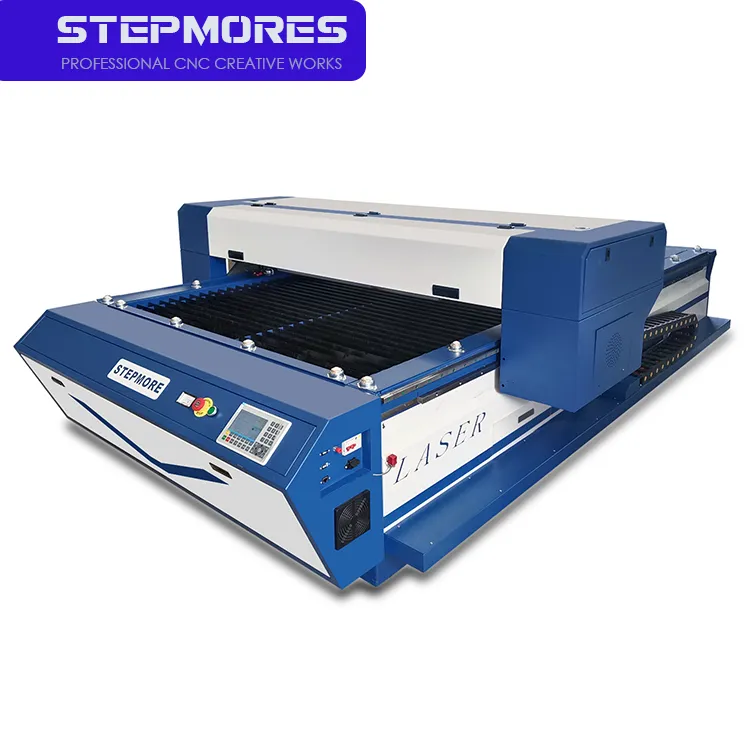
Material Compatibility and Cutting Performance of Your CO₂ Laser Cutting Machine
The CO₂ laser cutting machine excels at processing non-metal materials, but its performance hinges on matching the laser’s 10.6 µm wavelength and thermal interaction to the substrate. A poorly chosen material can lead to charring, toxic fumes, or even hardware damage. The following subsections break down optimal practices for organic and synthetic materials—and clarify why metals require a fundamentally different approach.
Optimizing for Non-Metals: Acrylic, Wood, Plastics, and Textiles
Acrylic is the benchmark material for CO₂ lasers: its strong absorption at 10.6 µm yields flame-polished edges with ±0.1 mm dimensional tolerance—ideal for signage, displays, and precision prototypes. Hardwoods, plywood, and MDF cut cleanly, though resin-rich (e.g., pine) or highly fibrous boards tend to char; reducing power and increasing speed minimizes heat-affected zones. For plastics, selection is critical: PVC must be avoided entirely, as it releases corrosive chlorine gas that damages optics and poses serious health risks. ABS and polycarbonate are prone to melting or burning and often require sacrificial masking film and precise parameter tuning. Natural and synthetic textiles—including cotton, linen, and polyester—cut with high edge fidelity and no fraying, enabling intricate apparel and décor applications. Always test on the actual machine using representative material thickness and grade to finalize speed, power, and focus settings.
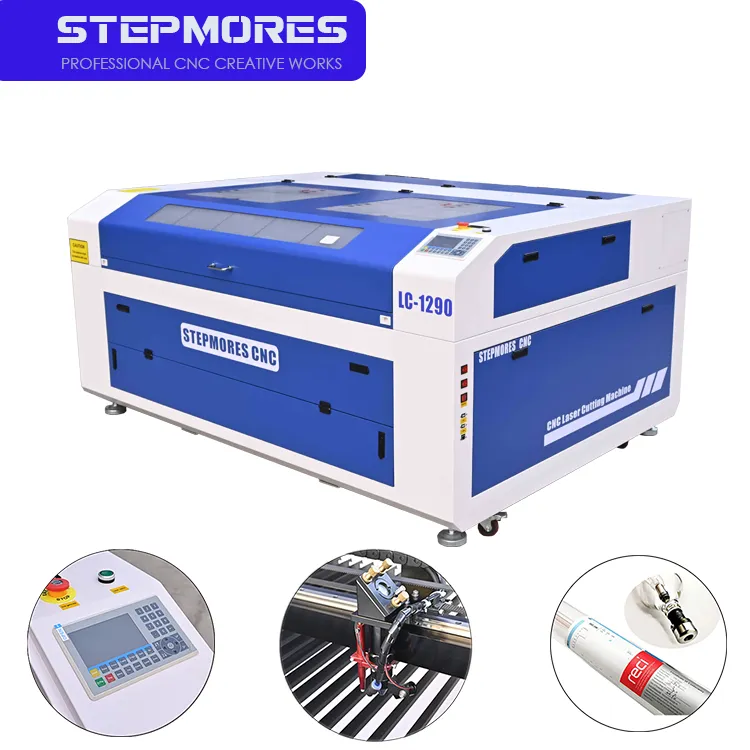
Why Metals Require Alternatives—and When Hybrid Workflows Make Sense
Bare metals—including steel, aluminium, brass, and copper—strongly reflect the CO₂ laser’s infrared beam rather than absorbing it. This reflection risks optic damage and offers poor energy coupling. Even with high-power tubes, results include wide, irregular kerfs and excessive heat-affected zones. True metal cutting demands the 1.06 µm wavelength of fibre lasers, which metals absorb efficiently. That said, hybrid workflows are both practical and widely adopted: CO₂ lasers excel at marking anodised aluminium or cutting non-metal components, while a dedicated fibre system handles metal fabrication. Many production shops deploy both technologies to cover the full material spectrum—leveraging the CO₂ machine’s unmatched versatility on acrylic, wood, and textiles without compromising on metal capability.
Key Technical Specifications That Define CO₂ Laser Cutting Machine Performance
Laser Power (40W–150W): Balancing Speed, Depth, and Edge Quality
Laser power directly governs cutting speed, maximum material thickness, and edge finish. Within the typical 40 W–150 W range, most non-metal workshops achieve optimal balance between prototyping agility and light production throughput. A 40 W tube cleanly cuts paper, leather, and up to 4 mm acrylic—but slows significantly on thicker stock, raising charring risk. Mid-range 60–80 W systems handle 6 mm wood and acrylic at practical speeds, while 100–150 W units cut 12–20 mm acrylic in a single pass and double throughput on 6 mm sheet. Higher wattage, however, can widen the heat-affected zone and reduce edge polish on sensitive plastics like cast acrylic or PETG. Industry benchmarks indicate a 60 W machine cuts 6 mm acrylic at ~15 mm/s, versus ~25 mm/s for a 100 W system. Matching power to your thickest routinely processed material avoids underperformance and unnecessary operating costs.
Beam Quality (M²) and Focus Stability: Ensuring Precision and Kerf Consistency
Beam quality—expressed as the M² factor—measures how closely the laser output approximates an ideal Gaussian beam. An M² value below 1.2 enables a focused spot size of ≤0.1 mm and a longer depth of field, ensuring uniform kerf width across variable-height or layered workpieces. This consistency is essential for fine-feature cutting and high-resolution engraving. Equally critical is focus stability: thermal drift in the resonator or misalignment in the optical path shifts the focal plane, causing tapered edges and inconsistent kerf. High-end CO₂ machines integrate temperature-stabilized resonators or real-time focus compensation to maintain spot position. Systems combining M² < 1.2 with active focus control limit kerf variation to under 0.05 mm over a 1 m² bed—a level of repeatability that reduces scrap and rework, especially in dense nesting or multi-layer applications.
Operational Readiness: Bed Size, Cooling, Ventilation, and CNC Integration
Selecting Bed Dimensions for Current Needs and Scalable Production
Bed size directly shapes production flexibility and long-term viability. A rigid, welded steel bed weighing ≥450 kg provides effective vibration dampening and preserves geometric accuracy over time. For small workshops or design studios, a 600×900 mm bed supports most prototyping and short-run jobs. Scaling to 1600×2500 mm accommodates full-sheet processing (e.g., standard 4′×8′ panels) and future growth. Large-format beds up to 4 m × 12 m enable oversized part fabrication without seam welding—reducing assembly time and part count. Thermal stability matters too: cast-iron or polymer-composite bed constructions minimise expansion during continuous operation, maintaining kerf precision across shifts. Modular designs—with optional bed extensions or auxiliary work zones—offer a cost-effective upgrade path, deferring full machine replacement as demand scales.
Critical Infrastructure: Air Cooling, Fume Extraction, and Safe Operation
Beyond the machine itself, supporting infrastructure determines safety, uptime, and optical longevity. Air cooling or closed-loop water chillers stabilise the laser tube’s operating temperature, preventing power drift and extending tube life by up to 30% compared to passive cooling. Fume extraction is non-negotiable: closed-bed machines typically integrate HEPA- and activated-carbon filtration, while open-bed configurations require properly sized external ducting to remove volatile organic compounds (VOCs), particulates, and hazardous gases—especially when cutting coated or composite materials. Proper ventilation also protects operator health and prevents residue buildup on mirrors and lenses. Floor load capacity and ceiling height must align with the machine’s footprint and exhaust requirements; large open-bed models may need reinforced flooring and roof-mounted extraction. Integrating these systems with the CNC controller enables automated monitoring of coolant temperature, airflow rate, and filter status—reducing manual checks and unplanned downtime.
Total Cost of Ownership for Your CO₂ Laser Cutting Machine
3-Year TCO Breakdown: Software, Maintenance, Optics, Consumables, and Downtime
The 3-year total cost of ownership (TCO) for a CO₂ laser cutting machine extends well beyond the initial purchase price. Software licensing typically ranges from $500–$3,000 annually, depending on feature set and update frequency. Routine maintenance—including alignment, cleaning, and calibration—averages $2,000–$5,000 per year, according to 2023 industry data from the International Laser Manufacturing Association. Laser tubes require replacement every 1–2 years at $500–$2,000 each, while lenses and mirrors wear gradually and should be budgeted for quarterly or semi-annual replacement depending on usage intensity. Unplanned downtime—often exceeding $100/hour in labour and opportunity cost—can quickly erode margins if not mitigated through proactive service contracts and operator training. Factoring in all these elements ensures realistic budgeting and supports long-term profitability.
FAQ Section
What materials are ideal for CO₂ laser cutting?
Acrylic, wood, and textiles are ideal materials for CO₂ laser cutting. Plastics like PVC should be completely avoided due to toxic fumes.
Why can’t CO₂ lasers cut metals effectively?
Metals strongly reflect CO₂ laser beams instead of absorbing them. Fibre lasers are required for effective metal cutting due to their 1.06 µm wavelength.
What factors should I consider when selecting a CO₂ laser machine?
Consider laser power, beam quality (M²), bed size, cooling, ventilation, and integration with CNC systems to match production requirements and scalability.
What is the lifetime cost impact of a CO₂ laser machine?
The 3-year TCO involves software, maintenance, consumables, downtime, and infrastructure costs, averaging $2,000–$5,000 annually for upkeep.
How do hybrid workflows maximize laser efficiency?
Hybrid workflows leverage CO₂ lasers for non-metal processing and fibre lasers for metals, ensuring full material versatility without compromising performance.
Table of Contents
- Material Compatibility and Cutting Performance of Your CO₂ Laser Cutting Machine
- Key Technical Specifications That Define CO₂ Laser Cutting Machine Performance
- Operational Readiness: Bed Size, Cooling, Ventilation, and CNC Integration
- Total Cost of Ownership for Your CO₂ Laser Cutting Machine
- FAQ Section