
The Unreachable Geometry Problem
A few years ago, a prototype shop owner in the Midwest faced a recurring nightmare. His team would spend days machining complex molds for a client, only to find that a deep cavity or an undercut required a second setup. The repositioning introduced tiny errors, and each correction took hours. The client was growing frustrated with the lead times and inconsistencies. The shop had hit a wall with its 3-axis machines. Then the owner invested in a 5-axis CNC router. Within weeks, the same complex molds were coming off the machine in a single setup, with perfect alignment and a smooth finish that required almost no handwork. The shop's reputation for quality work grew, and the owner started bidding on jobs he would have dismissed as impossible. This is the power of the fifth axis.
How a 5 Axis CNC Router Differs from 3 Axis
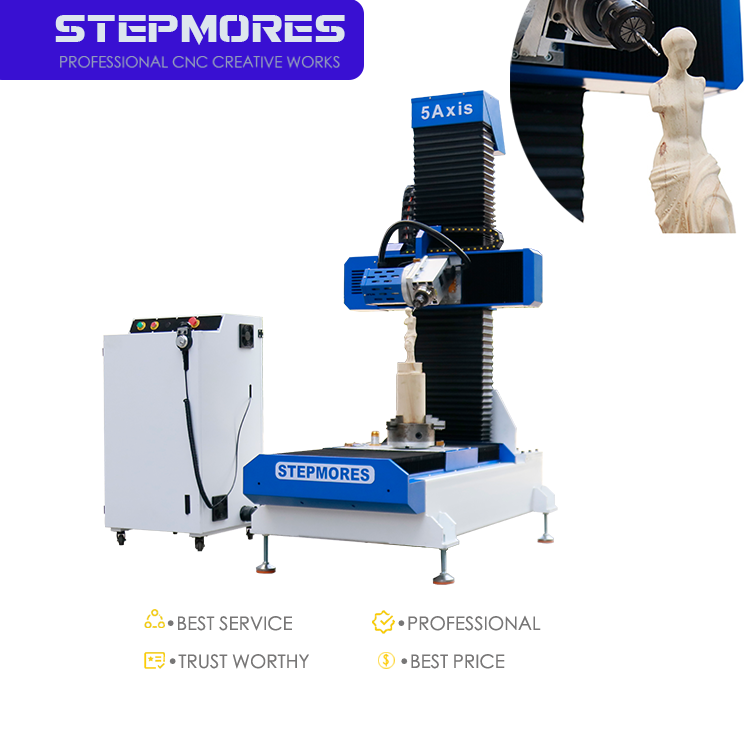
A 3-axis CNC router moves along three linear axes: X (left-right), Y (front-back), and Z (up-down). This configuration works well for flat panels, signs, and simple 2.5D profiles. But when a part has overhangs, deep pockets, or freeform surfaces, the 3-axis approach runs into serious limitations. The tool often cannot reach the required area without colliding with the workpiece or the fixture. Even if it can, the tool's tip contact point changes, leaving a scalloped surface that requires extensive hand finishing. A 5-axis machine solves this by adding two rotational axes, typically a tilting spindle head or a rotary table. These additional movements allow the tool to approach the part from virtually any angle. The cutter can remain perfectly perpendicular to the work surface, maintaining constant engagement and producing a far smoother finish. For complex contouring and undercut machining, 5-axis technology excels where 3-axis machines struggle.
The Single Setup Advantage
The most immediate benefit of 5-axis machining is the elimination of multiple setups. A part that might require four or five separate clamping operations on a 3-axis machine can be machined in a single setup on a 5-axis machine. This single setup approach does three things. It dramatically reduces labor and time. It eliminates the accumulated errors from each repositioning. And it improves overall quality because the part's reference points never change. The industry term for this is "set it and forget it." The operator places the workpiece on the table, clamps it once, and the machine does the rest. In one example, a shop machining complex impellers for marine applications reduced total machining time by over 40% simply by moving from a 3+2 positioning strategy to full 5-axis simultaneous contouring. The improved surface finish also eliminated a polishing step.
Understanding 5-Axis Configurations: Simultaneous vs. 3+2
It is useful to distinguish between two different ways that 5-axis capability is used. In 3+2 machining, the rotational axes are used to position the tool at a fixed angle, and then the part is machined with standard 3-axis movements. This is simpler to program and often sufficient for parts with multiple flat faces or angled features. In full 5-axis simultaneous machining, all five axes move together during the cutting process. This is essential for complex freeform surfaces, like turbine blades or mold cavities with curved walls. The choice between the two approaches depends on the complexity of the parts. A shop that primarily produces structural brackets with angled holes might find 3+2 sufficient. A shop that specializes in sculptural prototypes or aerospace components will need true 5-axis simultaneous capability.
Applications That Demand 5-Axis Technology
The ability to produce complex 3D shapes makes 5-axis routers valuable across a wide range of industries. In aerospace, they machine structural components, wing ribs, and turbine blades from aluminum and composites. In automotive, they produce prototype parts, interior trim molds, and even complete dashboard forms. In marine, they are used to machine large plugs and molds for boat hulls and custom yacht interiors. In woodworking, they create curved staircases, sculptural furniture, and ornate architectural details. Many 5-axis routers can also handle a broad spectrum of materials, from hardwoods to engineering plastics, foams, and non-ferrous metals. For shops that take on complex custom work, 5-axis capability is the key to standing out in a crowded market.
What the Investment Delivers
Adding a 5-axis CNC router is a significant capital decision, but the return comes from multiple areas. Reduced setup time and labor costs are the most obvious. Improved accuracy and surface finish reduce or eliminate secondary finishing. The ability to take on more complex work opens new market opportunities and allows the shop to command higher margins. When a shop can produce parts that competitors cannot, pricing power shifts. One marine industry supplier reported that bringing 5-axis capability in-house reduced the cost of producing complex hull molds by over 30% and cut lead times in half, allowing them to win a major contract that had previously been out of reach. The machines are also more efficient in material usage, as complex parts can be nested more effectively.
Choosing a Reliable 5-Axis CNC Router Manufacturer
The performance of a 5-axis CNC router depends heavily on the quality of its construction and motion control system. A machine with a lightweight frame will flex under cutting forces, ruining accuracy. Inaccurate linear guides will leave visible tool marks. A poorly tuned servo system can cause vibration. This is where the experience of the manufacturer matters. STMCNC has been designing and building CNC routers for over fifteen years, supplying machines to workshops in more than sixty countries. Their 5-axis routers feature heavy-duty welded steel frames for rigidity, high-precision linear guides from reputable suppliers, and robust servo motor systems for accurate and smooth movement. They also offer flexible configuration options to match different production needs, from machining large marine molds to precise aerospace components. With a dedicated research and development department and strict quality control procedures, STMCNC ensures that every machine is built for consistent, reliable performance. For a shop looking to expand its manufacturing capabilities and compete in complex 3D markets, choosing a partner with proven engineering expertise and a global support network is essential to turning a major investment into a lasting competitive advantage.