
How a CO2 Laser Cutting Machine Works: Core Physics and System Architecture
Gas Discharge Physics and 10.6 µm Wavelength Generation
CO2 laser cutters create their beam using gas discharge principles. When electricity passes through a sealed mix of carbon dioxide, nitrogen, and helium, it gets those CO2 molecules pumping out photons right around the 10.6 micrometer infrared wavelength. Materials like wood, acrylics, and fabrics really soak up this wavelength, which means the energy stays focused where it needs to go. Inside the machine, light gets amplified as it bounces back and forth between two carefully positioned mirrors in what's called a resonant cavity. This produces that nice straight, powerful beam we all know from industrial cutting. What makes these lasers so good for detailed work? The intense heat they create basically vaporizes or melts away material while keeping surrounding areas pretty cool. That's why manufacturers love them for intricate designs and parts that need to stay dimensionally stable after cutting.
Five Fundamental Cutting Modes: Gasification, Melt, Oxidizing, Controlled Fracture, and Engraving
CO2 lasers dynamically adapt to material properties using five distinct thermal interaction modes:
- Gasification: Instant vaporization of thin, low-thermal-mass materials (e.g., paper, thin film) using high peak power
- Melt: Localized melting of polymers or non-ferrous metals, with assist gas (e.g., nitrogen) ejecting molten material
- Oxidizing: Exothermic reaction with oxygen assist—ideal for thick mild steel, boosting cut speed by up to 40% versus melt mode, though requiring post-processing to remove oxide scale
- Controlled Fracture: Thermal stress-induced cleaving of brittle substrates like glass or ceramic, preserving structural integrity
- Engraving: Low-power, raster-based surface ablation for markings, textures, or shallow relief—achieving resolutions up to 1200 dpi on anodized aluminum
Mode selection hinges on real-time adjustments to power density (kW/cm²), pulse profile, and assist gas type/pressure—balancing edge quality, speed, and post-processing needs.
Integrated System Components: Laser Source, Beam Delivery, Focusing Optics, CNC Controller, and Auxiliary Gas/Cooling
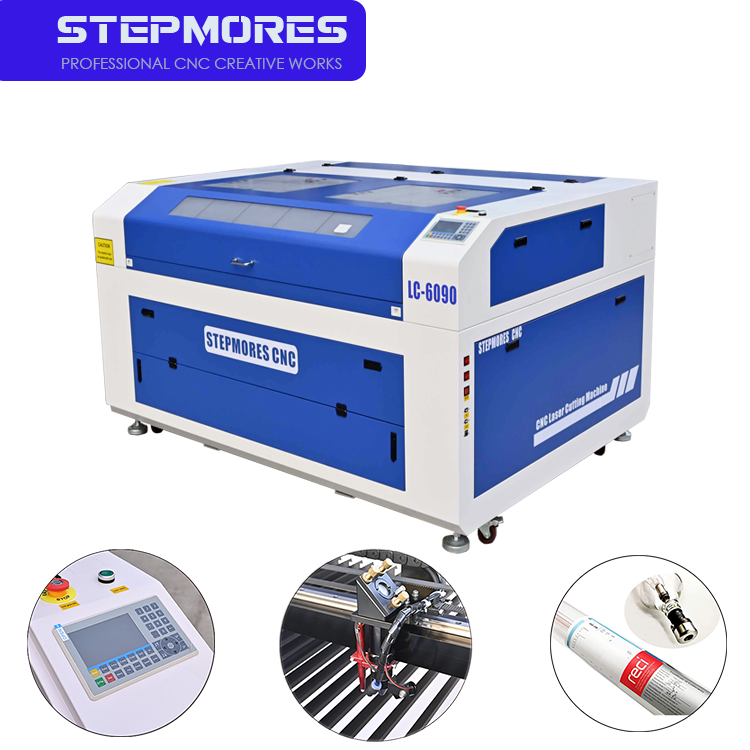
A CO2 laser cutting machine integrates five interdependent subsystems:
| Component | Function | Impact |
|---|---|---|
| Laser Source | Generates 10.6 µm beam via RF- or DC-excited gas discharge | Determines usable power range (40 W–20 kW) and beam quality (M² < 1.2 typical) |
| Beam Delivery | Mirrors (often water-cooled copper or dielectric-coated) guide light from source to work area | Maintains beam collimation and polarization over distances up to 30 m; alignment stability critical for repeatability |
| Focusing Optics | Zinc selenide (ZnSe) lens or reflective parabola concentrates beam to ~0.1 mm spot size | Enables precision cuts with positional accuracy ±0.05 mm and kerf widths as narrow as 0.15 mm |
| CNC Controller | Interprets CAD/CAM files, synchronizes motion axes (X/Y/Z), and modulates laser output in real time | Supports contour speeds up to 150 m/min and complex path interpolation for 3D contours and nested layouts |
| Auxiliary Systems | Chilled-water cooling maintains thermal stability; assist gases (N2, O2, compressed air) optimize cut dynamics | Prevents optical distortion during extended operation; nitrogen assist eliminates oxidation on stainless steel—reducing post-processing costs by an estimated $740,000/year in high-volume applications (Ponemon Institute, 2023) |
Material Versatility and Application Scope of the CO2 Laser Cutting Machine
Non-Metal Mastery: Wood, Acrylic, Glass, Fabrics, and Engineered Composites
CO2 lasers work so well on non-metallic materials because their 10.6 micrometer wavelength gets absorbed strongly by organic stuff and polar compounds. When working with dense hardwoods, the laser cuts through pretty clean if we control the heat properly, which means less charring than traditional methods. The same goes for cast acrylic pieces that basically vaporize during cutting, leaving behind edges that look almost like they've been polished optically. No need for extra finishing work here. Glass is another interesting case where the laser creates tiny fractures just right for etching or scoring without actually breaking the material, keeping its structural integrity intact. For synthetic fabrics like polyester or nylon, something cool happens too the cut edges actually seal themselves instantly, stopping any annoying fraying problems that plague mechanical cutting techniques. And let's not forget about those high-tech composite materials such as carbon fiber reinforced plastic. These can be separated along the fibers themselves with amazing precision sometimes within fractions of a millimeter accuracy. All this versatility opens doors for all sorts of applications ranging from simple display stands and model buildings right up to sophisticated interior components used in aircraft manufacturing. What makes it really special though is how everything can be done digitally without having to switch tools constantly during production runs.
Multi-Process Capability: High-Precision Cutting, Surface Engraving, and Rotary Cylinder Processing
Beyond planar cutting, CO2 systems perform three integrated functions via intelligent power and motion control:
- High-precision cutting sustains ±0.05 mm positional accuracy across 20 mm-thick acrylic, supporting tight-tolerance assemblies
- Surface engraving uses variable pulse modulation to achieve depth-controlled marking—from subtle branding on leather to tactile Braille on polymer surfaces
- Rotary processing, enabled by motorized chuck attachments, synchronizes axial rotation with Z-axis focus tracking—allowing seamless engraving or cutting on tumblers, pipes, or cylindrical signage
All operations share a single setup and calibration routine, eliminating workflow fragmentation for sign-making, promotional goods, or functional prototypes.
Industry-Specific ROI: Why Manufacturers Choose a CO2 Laser Cutting Machine
Packaging: Rapid Die-Cut Prototyping with Zero Tooling Lead Time
CO2 lasers cut out the need for making physical dies altogether, letting designers create packaging prototypes almost instantly rather than waiting weeks for results. The speed boost means companies can test designs much faster, shrinking product launch timelines by around two thirds compared to old school methods. Smart software helps too - it arranges cuts so there's less wasted material, saving between 15% and 30% on raw materials. And because the laser maintains the same narrow cut width throughout, every fold line matches up perfectly when assembling finished products, which makes all the difference in quality control for manufacturers.
Signage & Retail: Vector-Cut Acrylic and Edge-Lit Panels with Consistent Finish
CO2-cut acrylic naturally offers excellent optical clarity and consistent edges without needing any extra polishing or flame finishing steps. When used for backlit displays, these materials spread light evenly across complex vector cut designs. Even with big panels measuring several feet across, dimensional accuracy stays within about 0.1 mm tolerance. For high end retail spaces where every detail matters, this kind of reliability means fewer mistakes and wasted time during installation. Retailers know that when products look perfect on display, customers form better opinions about the brand itself. That's why so many stores now specify CO2 cutting for their signage needs.
Textiles & Automotive Interiors: Sealed-Edge Cutting Without Fraying or Post-Processing
The non-contact, thermally sealed cut eliminates fraying in synthetic upholstery fabrics—removing overlocking, hemming, and edge-binding steps. Automotive Tier 1 suppliers report labor savings of 8–12 minutes per vehicle interior, alongside improved dimensional consistency in headliners and door panels. Delicate laminates and composites remain undeformed, preserving acoustic and structural performance.
Performance Economics: Tolerance, Throughput, and Total Cost of Ownership
Evaluating a CO2 laser cutting machine demands analysis across three interrelated performance pillars:
- Tolerance: Typical positional accuracy ranges from ±0.05 mm to ±0.1 mm—sufficient for high-integrity assemblies and nesting efficiency that reduces scrap by up to 25%
- Throughput: Modern gantry systems achieve linear speeds up to 100 m/min in thin materials (≤3 mm), with acceleration exceeding 3G—enabling rapid job turnover without sacrificing edge quality
- Total Cost of Ownership (TCO): While capital cost is visible, operational expenses dominate long-term economics—accounting for 60–70% of lifetime cost. Key drivers include energy use (50–100 kW/hour depending on power class), optics replacement (every 6–24 months), RF tube life (8,000–15,000 hours), and assist gas consumption. Energy-efficient models with automated beam calibration and predictive maintenance reduce unplanned downtime and extend consumable life—delivering measurable ROI over five years through lower scrap rates, reduced labor, and uninterrupted production.
FAQs
What materials can a CO2 laser cutting machine work with?
CO2 lasers are highly effective on non-metallic materials such as wood, acrylic, glass, fabrics, and engineered composites due to their absorbed wavelength.
How does a CO2 laser cutting machine achieve different cutting modes?
The machine adapts by adjusting parameters like power density, pulse profile, and assist gas types to achieve cutting modes such as gasification, melt, oxidizing, controlled fracture, and engraving.
What are the integrated components of a CO2 laser cutting machine?
The essential components include the laser source, beam delivery system, focusing optics, CNC controller, and auxiliary systems like gas and cooling mechanisms.
How does a CO2 laser cutting machine benefit manufacturers?
Manufacturers benefit through rapid prototyping, accurate cutting, and reduced tooling lead time, which improves efficiency and reduces material waste.
Table of Contents
- How a CO2 Laser Cutting Machine Works: Core Physics and System Architecture
- Material Versatility and Application Scope of the CO2 Laser Cutting Machine
- Industry-Specific ROI: Why Manufacturers Choose a CO2 Laser Cutting Machine
- Performance Economics: Tolerance, Throughput, and Total Cost of Ownership
- FAQs