
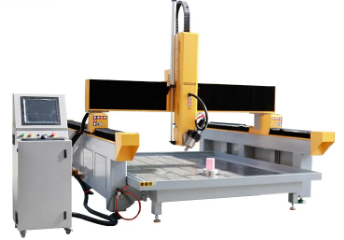
Why a 5-Axis CNC Router Delivers Superior Engraving Precision
Sub-0.03 mm positioning accuracy and thermal-stable servo tuning for micro-detail engraving
Today's 5 axis CNC routers can hit positioning repeatability below 0.03 mm thanks to solid monolithic frames, those super accurate ground linear guides, and closed loop servos that provide constant feedback. What does this mean practically? These machines can carve details finer than a single strand of human hair. That kind of precision matters a lot when marking medical devices for tracking, putting identifiers on aerospace components, or creating those tiny channels in microfluidics. The thermal compensated servos really shine during long runs too. They keep things stable so there's no drifting even after running non stop for hours on end. And don't forget about those B and C rotary axes with less than 0.01 degree resolution. Together they make sure intricate textures get replicated faithfully across all sorts of complicated curves without any of that annoying interpolation errors that plague lesser systems.
RTCP compensation: Maintaining tool center point fidelity during dynamic oblique and curved-surface engraving
The Rotational Tool Center Point (RTCP) compensation plays a vital role in keeping the tool properly aligned with the workpiece during those complicated 5-axis movements. Imagine when the machine's spindle tilts at 45 degrees while carving turbine blades or goes past 90 degrees into those tricky undercut areas. That's exactly when RTCP kicks in, constantly adjusting the XYZ coordinates as needed so the cutting tool stays precisely where it should be. Without this feature, we'd see those annoying step-like patterns form on curved surfaces, not to mention potential damage from improper contact during angled cuts. For jobs involving titanium aerospace molds that need rotations up to plus or minus 320 degrees, RTCP maintains an impressive 0.05 mm depth consistency even through these challenging angle changes. This means better surface quality overall compared to traditional methods which either sacrifice precision or demand several separate machining setups just to achieve similar results.
Continuous 5-Axis Linkage: Enabling Sculptural, Undercut, and Multi-Angle Engraving
Simultaneous XYZBC motion for single-setup hollow processing, bevels, and organic 3D relief engraving
The 5 axis CNC router moves along three straight lines (X, Y, Z) plus two rotation points (B, C) at the same time, which makes real simultaneous machining possible. With this setup, it can carve out those tricky deep hollow spaces, steep angles, and complex 3D shapes all in one go without needing to stop and reposition the workpiece or do extra steps later. The router keeps changing how the cutting tool faces the material based on what's happening on the surface, so it doesn't mess up those really curved areas while still keeping measurements within about 0.02 mm tolerance. What does this mean for production? Machines running these systems typically finish jobs around 75% quicker than older 3 axis methods. Plus, designers get creative freedom similar to what was once only possible with 3D printing techniques, opening doors for things like nature inspired textures and medically precise models that match human anatomy exactly.
Real-world example: Turbine blade mold engraving with ±320° rotation and full 5-axis toolpath continuity
The real world application of full 5 axis machining becomes clear when looking at turbine blade molds. These parts have those complicated airfoil shapes that need continuous cutting paths over all those twisty, double curved surfaces. When engraving these blades, the part actually spins around almost 360 degrees while the machine head tilts and turns constantly to stay perfectly aligned with whatever part of the surface it's working on right then. This kind of setup keeps the surface roughness below 0.4 microns and gets rid of those annoying seams and gaps that happen when switching between different machining stages. And what does that mean? Better airflow characteristics once everything is assembled. Shops that switched to this technology are seeing their production cycles cut down by about half and practically no waste material anymore compared to older techniques. Makes sense why companies investing in aerospace or medical devices where quality matters most would want to make the switch despite the upfront costs.
CAM Software Intelligence: Generating Reliable Toolpaths for Complex Engraving on a 5-Axis CNC Router
Collision-free, surface-adaptive toolpath generation in Fusion 360 and PowerMill for organic and high-curvature parts
Good CAM software acts as the brain behind reliable 5 axis engraving work. Software platforms such as Autodesk Fusion 360 and PowerMill create tool paths that avoid collisions and align properly with surfaces. They do this by looking at CAD models in real time and automatically adjusting things like lead lag angles, step over distances, and how fast the tool moves along curved surfaces. The smart algorithms keep pressure on the tool steady when working through complex shapes. This helps reduce vibration during cutting and keeps those tiny details sharp and clear. Before any actual machining happens, built in simulations check all the movements of each axis. This catches potential problems where tools might hit fixtures or damage parts. Some systems can recognize features in designs which cuts down programming time significantly. These programs maintain really tight tolerances too, often within about 0.03 mm accuracy. Whether it's making turbine blades or medical devices like skull implants, the precision stays consistent across different materials and shapes.
High-Value Applications: Where 5-Axis CNC Router Precision Drives Industry Innovation
Components made with 5 axis CNC routers are changing how things get built in industries where mistakes just won't do. Take aerospace for instance these machines can make turbine blades and housing parts that have those super smooth aerodynamic shapes down to the micron level. This matters because better precision means planes burn less fuel, generate more power relative to their weight, and stay safer in the air. Medical companies also depend on this tech to craft implants from materials like titanium and cobalt chrome. These implants need special porous textures that mimic real bone structure plus tiny surface features that help bones grow around them naturally. Getting those right makes all the difference when someone heals after surgery. Car makers aren't left out either they use five axis machines to build lighter but stronger parts like brackets and intake manifolds that actually contain fluid passages inside them. This lets cars lose weight without becoming flimsy. And let's not forget about energy production where this same technology creates turbine casings, impellers, and heat exchange parts that must handle extreme temperatures and pressures day after day while still keeping their shape intact for years on end.
FAQs about 5-Axis CNC Routers
What is a 5-axis CNC router?
A 5-axis CNC router is a computer-controlled machine that moves a cutting tool or part along five different axes simultaneously, allowing for complex shapes and designs to be manufactured without needing additional setups.
How does RTCP compensation work in 5-axis CNC routers?
RTCP compensation keeps the tool properly aligned with the workpiece during complex 5-axis movements, adjusting XYZ coordinates as needed to maintain precise tool placement and better surface quality.
What industries benefit from 5-axis CNC router technology?
Industries such as aerospace, medical device manufacturing, automotive, and energy production benefit from 5-axis CNC router technology due to its ability to produce high-precision and geometrically complex parts efficiently.
How does CAM software aid in 5-axis CNC operations?
CAM software generates collision-free toolpaths, adapts to surface contours, and optimizes cutting conditions, ensuring that 5-axis CNC operations are efficient, accurate, and safe.
Table of Contents
- Why a 5-Axis CNC Router Delivers Superior Engraving Precision
- Continuous 5-Axis Linkage: Enabling Sculptural, Undercut, and Multi-Angle Engraving
- CAM Software Intelligence: Generating Reliable Toolpaths for Complex Engraving on a 5-Axis CNC Router
- High-Value Applications: Where 5-Axis CNC Router Precision Drives Industry Innovation
- FAQs about 5-Axis CNC Routers