
The Evolution of Precision: Why Oscillating Knife CNCs Redefine Flexible Material Processing
The manufacturing landscape has shifted significantly. For facilities processing soft substrates—ranging from industrial-grade gaskets and rubber to specialized acoustic foams and technical textiles—the challenge lies in balancing speed with material integrity. Traditional die-cutting methods often prove too rigid and costly for rapid prototyping, while thermal cutting alternatives risk edge degradation or localized material deformation. An oscillating knife CNC system represents the professional standard for resolving these friction points. By utilizing high-frequency, precision-controlled vertical blade movement, this technology allows production teams to handle diverse materials with a level of accuracy previously unattainable through manual or legacy mechanical methods.
The Physics of High-Frequency Oscillation
At the heart of a superior oscillating knife CNC is the ability to maintain structural integrity through high-speed kinetic energy. Unlike static blades that rely on brute force to penetrate material, an oscillating tool utilizes a vertical stroke movement, oscillating at thousands of cycles per minute. This motion effectively slices through substrates rather than tearing or pushing against them. In professional practice, this is crucial for dense foam or multi-layered textiles where lateral tension would typically result in fraying or uneven edges. By isolating the cutting force to a pinpoint vertical action, the system ensures that the substrate remains completely stationary during the process, virtually eliminating distortion in high-precision components and specialized industrial seals.
Material Integrity Through Cold-Cut Mechanics
In high-standard manufacturing environments, thermal influence is often the enemy of precision. While some cutting systems introduce thermal energy that may melt the edges of polymers or leave discolored halos on synthetic fabrics, the oscillating knife CNC operates entirely through mechanical action. Adopting this "cold cutting" approach ensures that the heat-affected zone is non-existent. This ensures that the material retains its original chemical composition and structural strength, which is a fundamental requirement for maintaining the physical specifications of technical components used across various manufacturing sectors.
Transforming Operational Flow
Beyond the core mechanics, the value of an oscillating knife CNC lies in its seamless integration within the broader production workflow. Integrating these systems with advanced CAD/CAM software allows operators to transition from a digital design file to a physical finished product with minimal transition time. In large-scale operations, the use of intelligent nesting algorithms significantly optimizes material yield. By analyzing the grain, pattern, and shape of every part, the software minimizes skeleton waste, converting what was once considered scrap into usable material. This level of optimization transforms a cutting station into a strategic asset, where turnaround times for complex custom runs are handled with the same agility as high-volume cycles.
Versatility as a Competitive Edge
Modern manufacturing environments demand high levels of operational agility. A machine limited to a single material type often becomes a bottleneck. Leading oscillating knife systems are engineered to switch between diverse substrates seamlessly. Whether the requirement involves cutting rigid corrugated materials, soft felt, or abrasive compounds, the machine’s modular tool head allows for the fine-tuning of pressure, vibration frequency, and blade depth. This flexibility enables production teams to maintain a lean inventory and respond instantly to changing production demands without the downtime associated with re-tooling or changing physical dies.
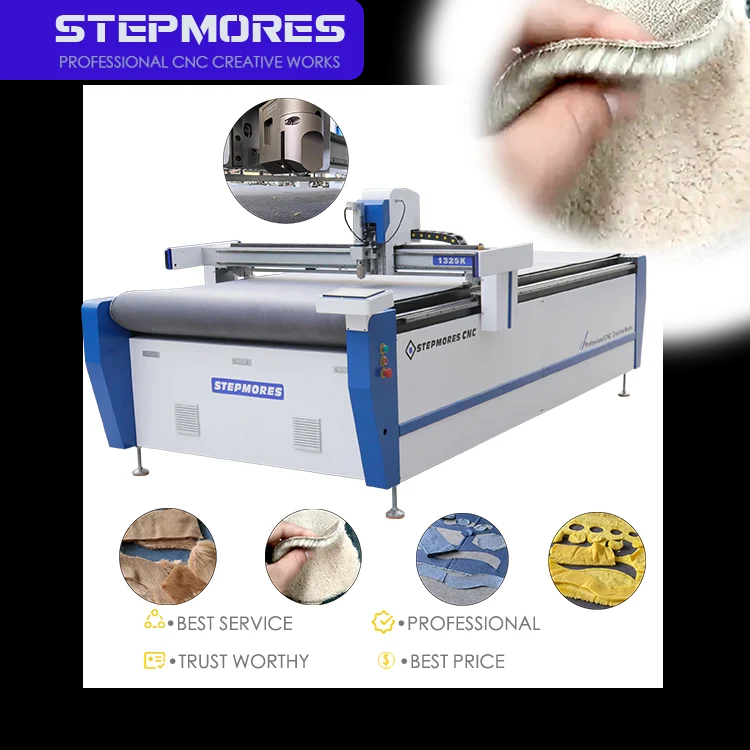
Industrial Integration with Stepmores
Successful deployment of CNC technology requires more than just high-quality machinery; it demands a deep understanding of manufacturing workflows and supply chain constraints. Stepmores has built a reputation for providing industrial-grade cutting solutions that emphasize long-term operational reliability. By combining cutting-edge engineering with robust technical support and a deep capacity for global supply chain services, Stepmores enables manufacturers to scale their operations with confidence. When production teams integrate technology from a proven industry partner, they ensure that every cut is backed by a commitment to performance and consistent quality, turning technical capabilities into sustainable competitive advantages for businesses operating in a global market.