
The Strategic Guide to Selecting a CNC Router for Woodworking Excellence
Transitioning a workshop from manual labor to automated precision represents a pivotal moment for any woodworking enterprise. The challenge lies not just in selecting a machine, but in choosing a technological partner that aligns with specific production goals, material throughput, and long-term scalability. A CNC router is a significant capital investment; making the right choice determines whether a production line operates with seamless flow or encounters recurring technical hurdles.
Mastering Spindle Dynamics for Production Consistency
The spindle acts as the heartbeat of the entire system. In professional environments, relying on undersized or poorly cooled spindles is a common oversight that leads to operational bottlenecks. During years of overseeing production setups, it has become evident that torque retention under heavy load is far more critical than raw horsepower ratings alone. For high-volume cabinetry or large-format architectural millwork, water-cooled spindles often provide superior noise reduction and consistent thermal stability during extended cutting sessions. Conversely, air-cooled variants offer simplified maintenance for shops that prefer avoiding coolant circulation systems. The goal should always be to match the spindle’s duty cycle to the density of the wood being processed. Pushing equipment beyond its thermal limits is a shortcut to premature wear, which directly impacts the bottom line.
Structural Integrity as the Foundation of Precision
Precision in woodworking is non-negotiable. Many operators underestimate the role of structural rigidity until they face inconsistent joint fitting or rough edge finishes that require labor-intensive manual sanding. A CNC router frame must be engineered to dampen high-frequency vibrations that occur during rapid-fire tool changes and aggressive cutting paths. Look specifically for heavy-duty, stress-relieved steel frames rather than lightweight aluminum extrusions. When observing machines on the factory floor, the gantry’s weight and the drive system’s quality—whether rack-and-pinion for speed or ball-screw for fine-tuned precision—reveal much about the manufacturer’s design philosophy. Machines built to industrial standards offer a level of repeatability that allows for true batch production, ensuring that components are identical in quality from the first to the last.
Optimizing the Workflow through Software and Controller Integration
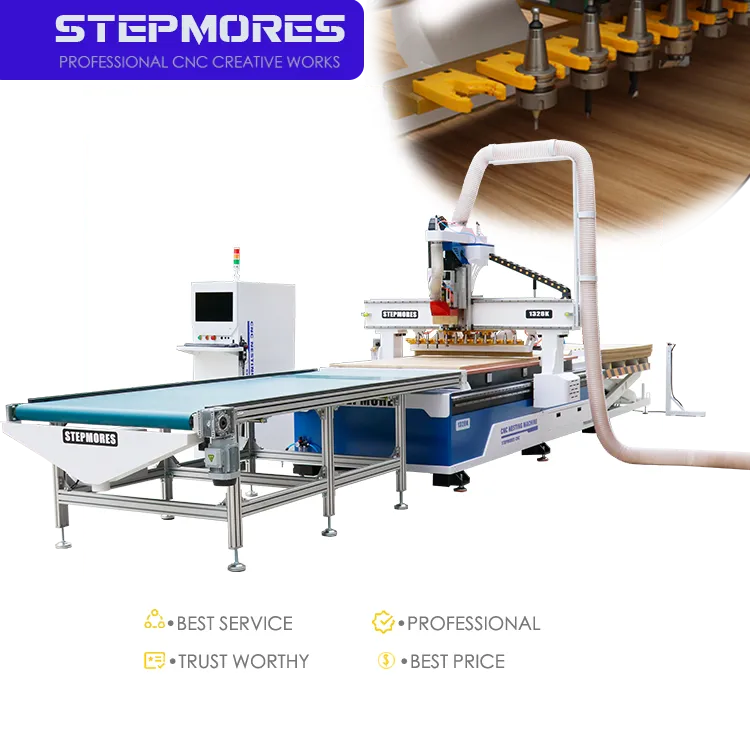
An industrial CNC router is only as sophisticated as the controller driving its motion. Modern production environments demand seamless integration between design files and the machine's operational logic. Using industry-standard CAD/CAM software is a baseline requirement, but the real advantage lies in how the machine handles the data. Dedicated DSP controllers or PC-based systems that minimize latency ensure that complex 3D surfacing and intricate joinery are executed with fluid motion. Furthermore, the ability to pre-program tool changes—or utilize Automated Tool Changers—drastically reduces operational downtime. When an operator spends less time manually swapping bits and more time prepping the next batch, the productivity gains become exponential.
Scalability and Future-Proofing Production Capacities
The most successful manufacturing facilities are those that remain agile. When sourcing machinery, consider the modular potential of the equipment. Will there be a need to add a multi-zone vacuum table later to accommodate smaller, nested parts? Does the current setup allow for the integration of specialized cooling for specific materials or additional rotary axes for turning? Investing in a system that can grow alongside production needs is a far more strategic move than selecting a machine for today that becomes obsolete in two years. This scalability often depends on the manufacturer's commitment to supporting their clients with modular upgrades and readily available technical components.
Building Success through Professional Partnerships
In the competitive landscape of modern woodworking, the quality of your supply chain partners is just as vital as the quality of your tools. Reliable equipment requires consistent technical support and an intimate knowledge of industrial manufacturing standards. Partners such as Stepmores excel in providing the robust manufacturing capacity and specialized supply chain support that keep production lines running at peak performance. By focusing on high-precision engineering and ensuring that every machine meets the rigorous demands of international manufacturing standards, Stepmores enables woodworkers to scale their operations with confidence. Choosing a partner that understands the intersection of artisanal requirements and industrial efficiency ensures that your woodworking production remains both creative and commercially dominant.
Table of Contents
- The Strategic Guide to Selecting a CNC Router for Woodworking Excellence
- Mastering Spindle Dynamics for Production Consistency
- Structural Integrity as the Foundation of Precision
- Optimizing the Workflow through Software and Controller Integration
- Scalability and Future-Proofing Production Capacities
- Building Success through Professional Partnerships