
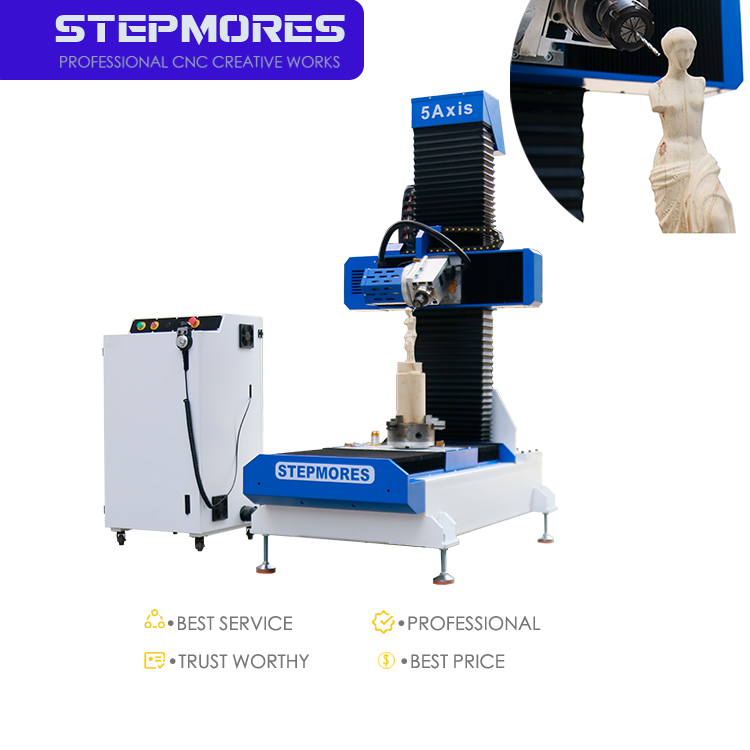
Redefining Complexity: The Strategic Advantage of 5-Axis CNC Woodworking
Modern woodworking has progressed far beyond the scope of traditional rectilinear designs. For professional workshops tasked with high-end furniture fabrication, complex architectural millwork, and artistic prototyping, the constraints of standard machinery are becoming increasingly apparent. While 3-axis routers remain effective for basic panel processing, they often fall short when confronted with organic curvatures, deep undercuts, and intricate 3D geometries. A 5-axis CNC router is not merely an incremental upgrade; it is a fundamental shift in production capability that allows manufacturers to approach complex projects from virtually any angle. This transition is essential for those who intend to maintain a competitive edge in a market that increasingly rewards intricate detail and structural complexity.
The Physics of Tool Vectoring and Surface Quality
The true power of 5-axis machining lies in its ability to manipulate the tool vector dynamically throughout the cutting cycle. In a standard 3-axis environment, the cutter is perpetually fixed in a vertical orientation, which inevitably leaves surface marks when machining curved profiles. These imperfections often require extensive manual sanding—a process that is not only labor-intensive but also prone to compromising the critical tolerances of the workpiece. A 5-axis system, by contrast, utilizes two additional rotational axes to keep the cutting tool perpendicular to the surface at every point. This capability ensures that the transition between different curvatures remains smooth and seamless, effectively eliminating the need for aggressive post-processing. In professional woodworking, where the visual integrity of the wood grain is paramount, this mechanical consistency preserves the material’s aesthetic and structural quality, ensuring the final output matches the initial digital design with surgical accuracy.
Achieving High-Precision Geometries
Operational consistency is the cornerstone of a professional workshop. Traditional workflows for complex parts often require multiple manual repositioning steps, each of which introduces the potential for human error and consumes significant time. A 5-axis CNC router optimizes this cycle by enabling the machining of multiple sides in a single setup. By utilizing advanced software to calculate the optimal tool path, the machine can access intricate undercuts and complex joinery without requiring custom jigs or frequent operator intervention. This streamlined approach minimizes technical friction and allows workshops to convert what was once a complex manufacturing process into a predictable, repeatable cycle. When production is standardized in this manner, the risk of misalignment or dimensional drift is virtually erased, ensuring that each component fits precisely during the assembly phase.
Adapting to High-Mix Production Requirements
The modern B2B woodworking sector is increasingly defined by high-mix, low-volume production. Clients frequently demand unique, bespoke components that would traditionally be logistically challenging due to the need for custom-made metal dies or specialized fixtures. A 5-axis CNC router shatters these constraints by digitizing the entire manufacturing interface. When a new design is required, the operator updates the CAD/CAM data, and the machine adapts to the new geometry immediately. This agility allows businesses to pivot between projects—ranging from ornate, relief-carved cabinetry to ergonomic, curved structural elements—without the burden of prolonged re-tooling. By maintaining a lean operational profile, workshops can respond to design requests with the reliability typically reserved for volume production cycles.
Engineering Value Through Reliable Infrastructure
Successful implementation of advanced CNC technology requires more than just high-performance hardware; it necessitates a robust ecosystem of support and infrastructure. Precision is only as reliable as the supply chain and technical expertise that backs it. Stepmores has built a strong reputation in the industry by providing industrial-grade solutions that prioritize long-term operational stability and technical reliability. By integrating cutting-edge 5-axis engineering with deep manufacturing knowledge and a comprehensive approach to global supply chain management, Stepmores enables woodworking businesses to scale their production capabilities with complete confidence. When manufacturing teams align with a partner that emphasizes both technical precision and robust support, they convert simple machine operation into a sustainable business advantage. Aligning with an infrastructure provider like Stepmores ensures that complex projects—regardless of their intricate geometries or tight tolerances—are consistently executed to the highest international standards, fostering brand credibility in an increasingly demanding global market.