
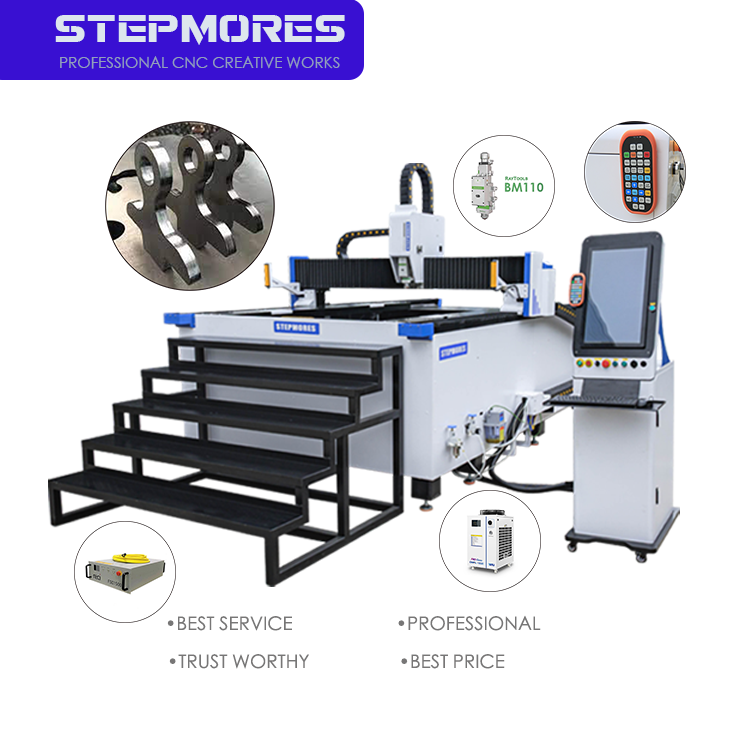
Unmatched Precision and Tolerance Control for Critical Industries
Sub-millimeter accuracy in aerospace, medical, and defense component fabrication
Precision at the sub-millimeter level is not a luxury—it is a non-negotiable requirement for industries where the smallest deviation can lead to catastrophic failure. A CNC fiber laser cutting machine routinely achieves tolerances within ±0.05 mm, making it indispensable for fabricating turbine blades, engine housings, surgical instruments, and RF shielding enclosures. Its non-contact operation eliminates tool wear and mechanical deformation, while integrated real-time feedback systems—such as laser measurement and touch probing—verify dimensions during the cut cycle. This ensures consistent compliance with AS9100 (aerospace) and ISO 13485 (medical device) standards across full production runs.
CNC programming flexibility enabling complex geometries and tight-tolerance repeatability
Modern fiber laser systems leverage advanced CNC programming to execute intricate geometries that conventional methods cannot match. Multi-axis tool paths, adaptive feed rates, and automated thermal compensation allow precise cutting of micro-serrations, fine internal features, and organic contours—even on large or thermally sensitive parts. CAM software optimizes motion control to maintain positional repeatability within microns, while real-time thermal algorithms dynamically adjust for material expansion. The result is design fidelity preserved across hundreds or thousands of identical parts, transforming geometric complexity into predictable, high-yield manufacturing.
Broad Material Versatility—Especially High-Performance and Reflective Metals
A CNC fiber laser cutting machine delivers exceptional performance across a diverse range of metals, serving as a single-platform solution for job shops and OEMs alike. Its ability to process both high-strength alloys and traditionally challenging reflective materials eliminates the need for secondary processes or dedicated equipment.
Reliable cutting of stainless steel, titanium, and hardened alloys at production speeds
The fiber laser’s 1 μm wavelength is efficiently absorbed by stainless steel, enabling clean, dross-free cuts up to 25 mm thick. Titanium responds exceptionally well—especially under inert gas shielding—producing oxide-free, biocompatible edges critical for implants and airframe components. Hardened alloys like Inconel and tool steel are processed without preheating, thanks to the laser’s rapid energy delivery, which minimizes the heat-affected zone and preserves edge hardness. At 1 mm thickness, stainless steel cuts exceed 20 m/min, ensuring even demanding materials sustain high throughput. This reliability stems from the solid-state resonator’s stable output over extended shifts—reducing scrap and rework in ISO-certified environments.
Stable processing of aluminum, copper, and brass using advanced beam modulation
Historically, reflective metals posed risks of back-reflection damage to older laser sources. Today’s CNC fiber laser cutting machines mitigate this through intelligent beam modulation—dynamically adjusting pulse duration, frequency, and peak power to stabilize the cut front and prevent optical feedback. Aluminum up to 6 mm thick now yields clean, square-edged profiles; copper and brass—once relegated to waterjet or plasma—are cut at speeds of 10–15 m/min on thin gauges, with minimal oxidation or distortion. Wavelength-optimized optics further improve absorption, enabling consistent quality across ornamental brass, heat-exchanger copper, and lightweight aluminum structures—without sacrificing throughput or edge integrity.
Operational Cost Efficiency: Minimized Waste, Maintenance, and Labor Dependency
Advanced nesting software leverages the fiber laser’s ultra-narrow kerf (<0.1 mm) to reduce material waste to under 2%—a dramatic improvement over traditional CO₂ or plasma methods, which typically waste 10–15% of raw stock. By optimizing part placement across sheets, nesting maximizes yield from every plate—directly lowering procurement costs, especially for premium materials like stainless steel, titanium, and aluminum.
The solid-state fiber source offers over 100,000 hours of operational life—more than three times that of CO₂ lasers (20,000–30,000 hours). With no consumable mirrors, lenses, or assist gases required, maintenance intervals extend from weekly or monthly to quarterly or annual. Downtime and service costs drop significantly, contributing to a lower total cost of ownership and higher machine availability.
| Cost Factor | Traditional CO₂ / Plasma | CNC Fiber Laser Cutting Machine | Savings Impact |
|---|---|---|---|
| Material waste | 10–15% | <2% | Up to 13% material cost reduction |
| Laser source lifespan | 20,000–30,000 hours | >100,000 hours | 3–5× longer, fewer replacements |
| Scheduled maintenance | Monthly | Quarterly or annual | Reduced labor hours and parts cost |
Labor dependency declines as well: automated nesting, parameter recall, and stable beam performance reduce manual oversight. One operator can manage multiple machines—including unattended “lights-out” operations—further driving down per-part labor costs. Together, these efficiencies position fiber laser cutting as a high-ROI investment for manufacturers prioritizing cost control without compromising quality or throughput.
Scalable Throughput and Automation Integration for High-Volume Manufacturing
Cutting speeds of 15–30 m/min on thin-gauge metals—2–3× faster than CO₂ or plasma
On thin-gauge metals, CNC fiber laser cutting machines achieve speeds of 15–30 meters per minute—two to three times faster than CO₂ lasers or plasma systems. This speed advantage directly boosts shift-based throughput and supports just-in-time delivery for automotive, electronics, and appliance manufacturers. For example, 1 mm stainless steel cut at 20 m/min yields a clean, dross-free edge requiring no secondary finishing—preserving both time and part integrity.
Seamless CNC fiber laser cutting machine integration with robotic loading, MES, and Industry 4.0 platforms
High-volume manufacturing demands intelligent, connected workflows—not just raw speed. Modern CNC fiber laser cutting machines integrate natively with robotic loading arms, automated material handling, and Manufacturing Execution Systems (MES) via standard protocols like OPC UA and MTConnect. This enables real-time data exchange for automatic job scheduling, predictive maintenance alerts, and live OEE dashboards. As a result, operators can oversee multiple laser cells simultaneously, while the system auto-adjusts parameters for varying material types and thicknesses. Changeover times shrink, uptime increases, and overall equipment effectiveness consistently exceeds 85%.
Frequently Asked Questions (FAQ)
Why is sub-millimeter precision critical for industries such as aerospace and medical?
Sub-millimeter precision is vital because any deviation can compromise safety and functionality, especially in industries like aerospace and medical, where reliability and compliance with strict standards are crucial.
How do fiber laser cutting machines handle reflective materials like aluminum and copper?
They use advanced beam modulation to dynamically adjust pulse duration, frequency, and power, stabilizing cutting fronts and preventing optical feedback, resulting in clean cuts and high-quality outcomes.
What are the cost advantages of using CNC fiber laser cutting machines over traditional methods?
Cost advantages include reduced material waste (<2%), longer laser source lifespan (over 100,000 hours), and minimized maintenance and labor costs due to automation and stability.
Can CNC fiber laser cutting machines handle high-volume manufacturing?
Yes, they offer fast cutting speeds (15–30 m/min) and integrate seamlessly with robotic loading systems, MES, and Industry 4.0 platforms to optimize high-volume production workflows.
Table of Contents
- Unmatched Precision and Tolerance Control for Critical Industries
- Broad Material Versatility—Especially High-Performance and Reflective Metals
- Operational Cost Efficiency: Minimized Waste, Maintenance, and Labor Dependency
- Scalable Throughput and Automation Integration for High-Volume Manufacturing
-
Frequently Asked Questions (FAQ)
- Why is sub-millimeter precision critical for industries such as aerospace and medical?
- How do fiber laser cutting machines handle reflective materials like aluminum and copper?
- What are the cost advantages of using CNC fiber laser cutting machines over traditional methods?
- Can CNC fiber laser cutting machines handle high-volume manufacturing?